
In my last three blogs I have described the decline of two species, the cosmopolitan red knot and the truly American bobwhite quail. These two species represent two distinct lines of people, birders and hunters, who are among a legion of people who self-identify as wildlife enthusiasts. Collectively they number nearly 88 million people or 30% of the US population. These people leave their homes to enjoy wildlife, they spend money to pursue birds by buying expensive gear and traveling great distances. Hunters and fishermen spend the most because they also buy permits and licenses. Bird watchers pay for the pleasure of birding. NJ Audubon will sponsor a trip to Belize this February that is nearly full. (click image for information)
The knot and quail are among the most popular species to thier respective enthusiasts and are the focus of many conservation agencies and groups. So why are these and other popular bird species declining so drastically? Perhaps a more focused question is why is this massive group of people not involved in solving these very solvable problems and why are they not challenging our conservation system to do a better job?
First why are wildlife people uninvolved? There are many reasons for this, most having to do with the urbanization of the US population. But over the 30 year arc of my own career, there has been a sea change in how people are involved in wildlife and their conservation. This change has reshaped the public’s relationship with wildlife. Bird banding illustrates my point.
 Hannah SothersDecades ago bird banding was a pursuit of a small but dedicated group of people, who were not professionals wildlife scientists, but smart people who cared about birds. They included people like Hannah B. Suthers, who still operates a long running banding operation in Hopewell, NJ. These people did the work because they loved birds so much they volunteered their time so that they could add important new information to our scientific understanding of bird ecology. As a result these folks have underpinned many important professional projects carried out by academics or agency scientists.
This system was similar to the current system in Great Britain and other European countries. There, banding is a recreational pastime accessible to all who are willing to go through rigorous mentoring to insure minimal impact to birds ( and willing to pay a steep price for bands). The US system has gradually morphed into one dominated by the pro’s. In fact, banding permits are not given to those who only want to band for fun, there must be a scientific objective. The ostensible reason is to weed out bad actors, but the outcome is to separate the bird loving public from this often inspiring but always tedious work that is rarely attractive to the pro’s. The British Trust for Ornithology has led bird ringing (banding) in the UK for 100 years. People are encouraged to band for fun, but only after a rigorous training program that often requires a long apprenticeship
The same is true of wildlife rehabilitation. In the past this was a passionate endeavor for people who cared for wildlife as much as others care for pets. The value of their work has always been questioned by wildlife biologists, if only because it was not likely to affect populations. Ironically permitting to save lives is a magnitude above permits necessary to kill wildlife (hunting licenses). Now permitting is so onerous few have the wherewithal to satisfy the many requirements. There are now so many rules about handling wildlife, including dead wildlife, that even teachers could be fined for holding animals for their classes.
Is it no wonder that Americans have grown into thinking that the conservation of wildlife is not their business?
As is often the case we can learn from old-timey wildlife managers. Hunters and fishermen play an integral role in the conservation of their prey, a situation not unlike the banders in the UK. Both pursue their sport for fun but at the same time it is inherently scientific. Hunter bag surveys, deer check stations, creel surveys and other hunter/fisherperson derived data, underpin scientific management of game and fish. This interaction is the heart of our game and fish management system that has successfully managed game wildlife for decades.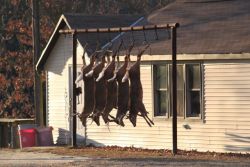 The killing of deer, a recreation for hundreds of thousands of NJ residents and millions across the nation, is the backbone of the scientific management system that helps maintains a healthy population. Similar hunter derived data comes from most hunted wildlife.
If conservationists want greater support for programs they need to allow greater access to wildlife. All the rules that were intended to protect wildlife from those who would do them harm, are choking out the people who could play a much more expansive role in their protection. All these rules should be rethought to allow the public greater access to wildlife.
At the same time we should rethink the delivery of conservation. For example the Delaware Bay horseshoe crab population is depleted and will take decades to recover according to new modeling conducted by the ASMFC ( I am on the team doing the modeling). The traditional approach to speed the recovery is to fight over harvests, a pursuit in which I am deeply involved. But there is a better way. What if thousands of people were inspired to come to the bay and save the lives of horseshoe crabs hopelessly caught in between bulkheads or in the crevasses of rocky groins? What if people were organized into a great effort to right overturned crabs, flipped by Delaware Bay waves? Would the crab recovery go from decades to a years if thousands of crab’s lives were saved by well-meaning people each year?
In other words can conservation, and the science on which it is based , be re-seen as recreation. In my next blog I will speak to the reason why the public doesn’t see the system working for them
