
At this early stage of the stopover, it’s hard to explain what will be clearer at the end. Stephanie Feigin, Humphrey Sitters, and I counted 26,000 red knots on May 17 between Norburys Landing and Reeds Beach South, a record for this section of the bay and this early in the season. So, we ask why? Has the number of knots gone up? It is a very unlikely possibility, given that the counts done elsewhere in the flyway remain unchanged. Yet we would all welcome that change; many of us have been waiting for 20 years for it. We would all breathe a sigh of relief. But it’s not likely.

6000 Knots roost at Pierces Point outer beach on 5.20.25
It could be that the birds feel safe on NJ Beach because we have a dedicated group of volunteers organized by Larissa Smith of Conserve Wildlife Foundation. I think this is very important, but the birds would not be here if they had no reason.
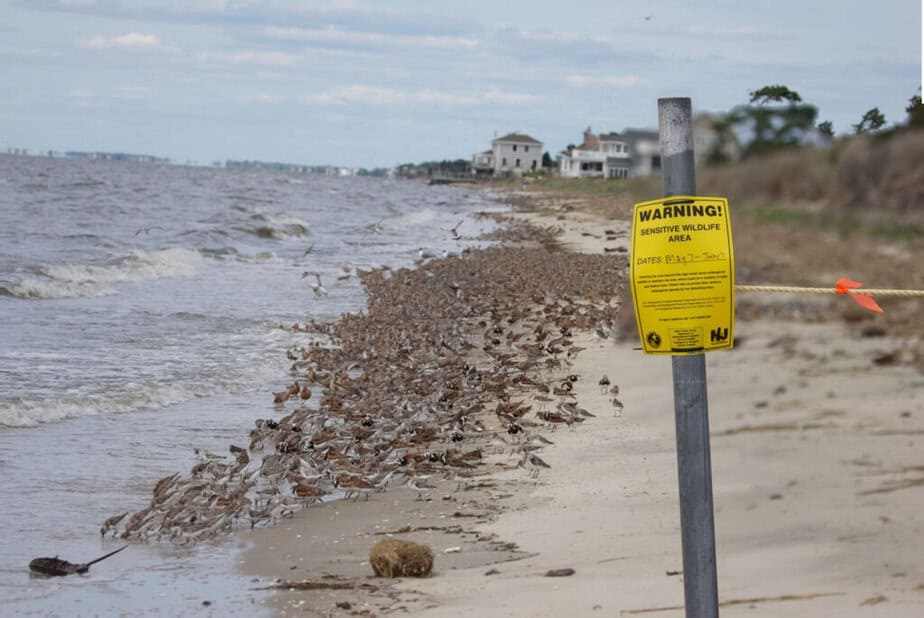
3000 knots and 1000 ruddy turnstones feed on the beach between Eldridge and Norburys, right up to the barrier constructed by NJ Fish and Wildlife to protect them. This proximity allows for good opportunities for nonthreatening photography and viewing because the birds feel safe if they can depend on people staying within the barriers of the observation areas.
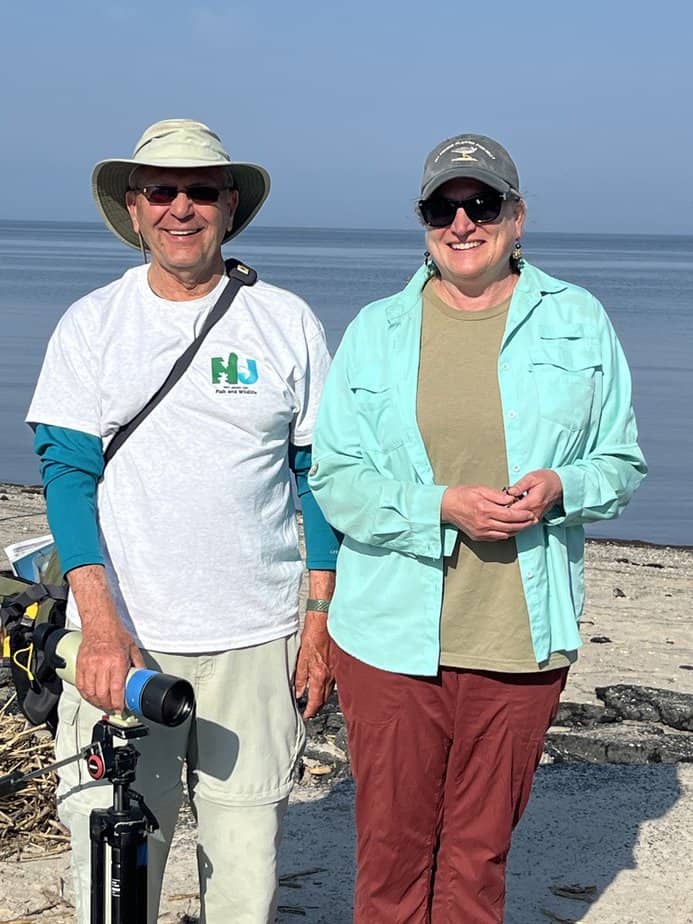
Larissa Smith with Conserve Wildlife Foundation of NJ, leads the volunteers who steward and educate visitors. She is with Neil Olafson, who is one of the first stewards, helping people since the program’s start in 2005
The most likely reason is the erratic availability of eggs. To understand this we have to remember the past. What we see now is nothing like the egg densities of the distant past, when eggs were so dense that they formed windrows a foot high on some beaches. In 1991, Mark Botton and Bob Loveland counted 50,000 eggs/m². Millions of shorebirds could depend on the abundance of eggs, and it didn’t matter if the spawning shut down for whatever reason; the beaches were filled with eggs, and shorebirds could rely on them year after year. See this video from a 1986 movie on shorebirds.
Now we are lucky to get 10,000 eggs/m2, and some beaches have even less. The low densities not only provide less food for the long-distance travelers arriving emaciated from their 10,000-mile flight, but they also create uncertainty. In 2020, we had virtually no eggs because the bay waters turned cold and delayed spawning until after the birds had left. In the succeeding years, the number of knots plummeted to new lows by our count. In other words, the birds’ experience in one year affects the numbers in the next.
Susan Linder, who leads our egg survey team, suggested early egg densities as a possible reason for the high red knot count. As you can see from her histograms of egg densities below, last year’s early-season egg spawn was one of the highest in the recent past. This year is the same, although it’s a bit lower. We had no high numbers of knots early in the season last year because birds couldn’t know of the abundance beforehand. But the birds that learned of early eggs returned with bigger flocks. At this point, we are only guessing, but soon our picture will focus.


The historgram above show the cluster and surface egg densities on NJ Delaware Bay from 2015 to the present. See the big increase at the start of 2024 and 2025

Horseshoe Crab egg densities in 2024 showing how we have an early burst of eggs that diminished in the second week and then a big spawn mid month. The overall egg densities were not much different than the previous 10 years, it just came in a few crucial weeks.
Unfortunately, just like last year, egg densities have already started to moderate because of persistent onshore winds. We have suffered three days of wind gusting to 30 knots and waves crashing on shore. Crabs can’t spawn in these conditions on beaches. But our shorebirds are still in luck because of the many shoals on the NJ side of the bay. Unlike the Delaware side of the bay and most estuarine areas on the East Coast, the bayside in NJ remains free of armored inlets. People armor inlets with stone jetties to stop erosion. But the bay’s shoreline, in its natural state, moves constantly, with sand generally moving south to north as incoming tidal currents sweep up the bayshore. Unarmored natural inlets build shoals from this sand. More sand moves to these inlet shoals as beaches naturally erode. This is our bay’s natural state.

An aerial photo of the shoals at Cooks Beach, NJ at low tide not long after American Littoral Society and WRP restored the Beach in 2020.
Shoals and the beaches protected by them have the highest egg densities of all the habitats on the bay. Shoals stop the onshore winds, allowing crabs to spawn even when winds turn foul, so we hope the birds can cope. It’s no accident that we have shoals. As in most of the previous 12 years, the America Littoral Society and Wildlife Restoration Partnerships restored one beach, Thompsons, and using our designs, the NJ DEP restored Baypoint. Over the last decade, we have restored all of the bay’s beaches important to crabs and shorebirds at least once and most twice. We added thousands of tons of sand; it erodes as all beaches do, but the sand is not lost. It builds shoals.
Two days ago, our trapping program felt like a forced march. Freaky bad weather and strong winds off the sea made the birds jumpy, moving around as though they couldn’t predict what would happen next – which they couldn’t. We can’t trap in winds this strong unless we aim off the wind, which limits our choices dramatically.
But yesterday our luck turned, and we were able to make two catches: one of sanderlings with a handful of red knots and ruddy turnstones, then a bigger catch of knots and turnstones. In total, we caught nearly 300 birds, all measured and flagged, and all turnstones were sampled for avian influenza, with feather and blood samples taken from all knots. Stephanie, Joanna Burger and Gwen Binsfeld attached five more satellite transmitters. With all our goals met, we are taking a day of rest.

The NJ Shorebird Team setting a cannon net. In the picture Jay Bolden, John Bloomfield, Ren Monte,Stephanie Feigin, Humphrey Sitters, Antonio Brum and Gwen Binsfeld.

