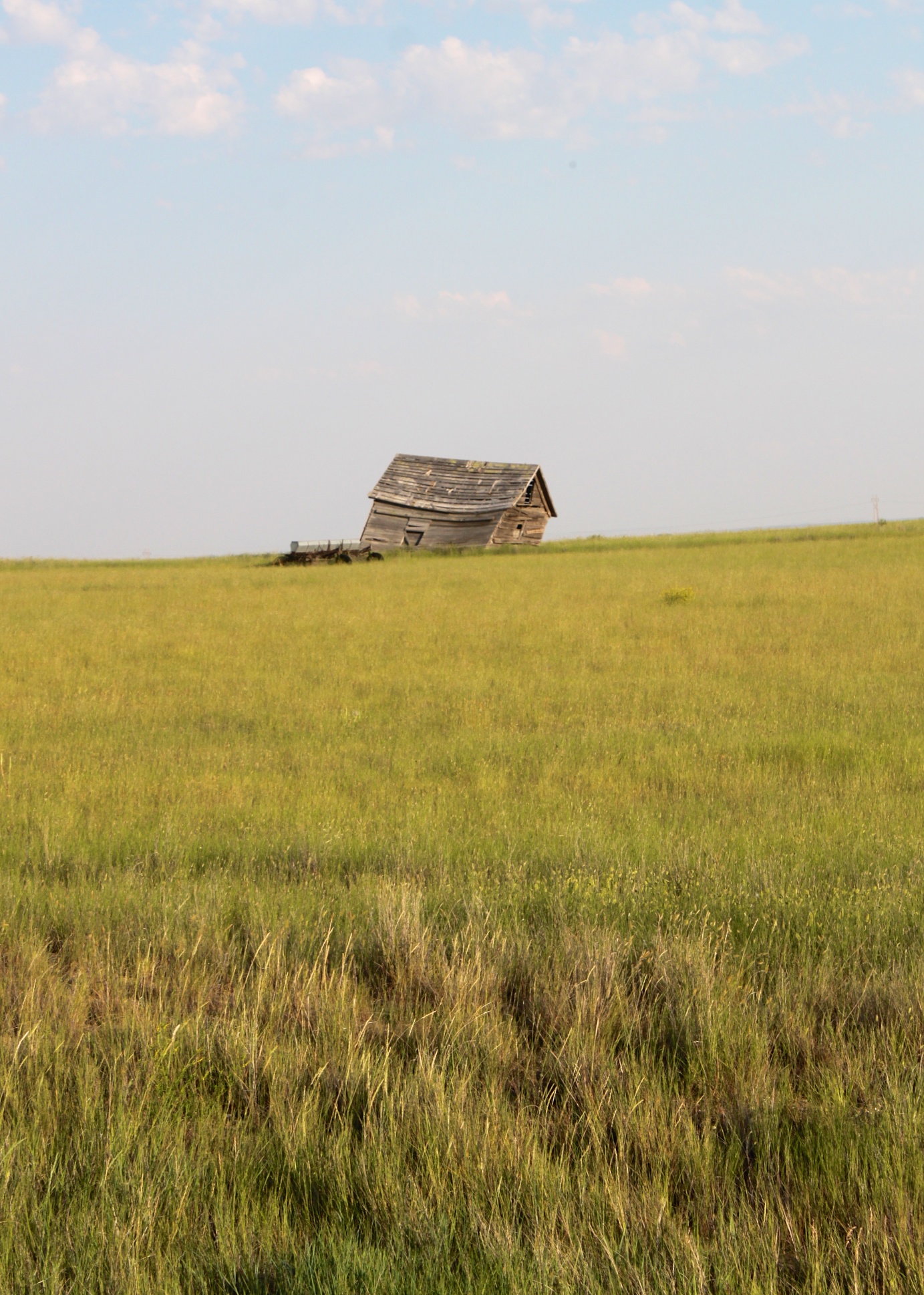
There once existed a habitat in southern NJ that was both ubiquitous and unseen and is now virtually gone. Historically, farmers viewed this habitat, the interface between tidal marsh and agricultural field, as wasted land. They did their best to keep it productive but periodic inundation by storm-surge tides decreased the capacity of the soil. Oftentimes livestock grazed this ribbon of transitional habitat along with the salt marsh which was largely impounded by dikes during the 19th and early 20th centuries throughout the Delaware bayshore. The habitat, known by Europeans as a wet meadow, snaked throughout the bay’s farmlands providing a home to many species like northern harriers, the sedge wren and Henslow’s sparrow.
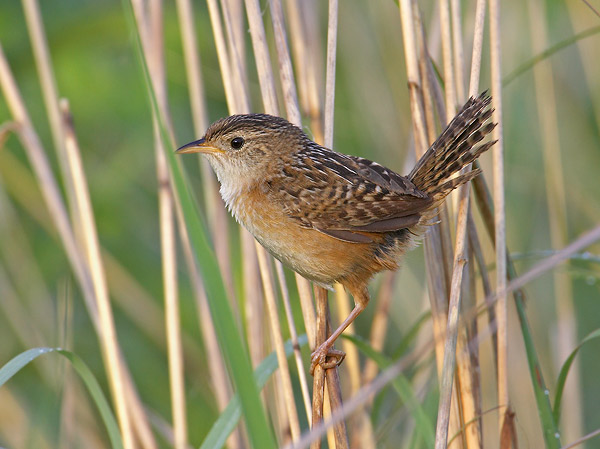 sedge wren
Now this habitat and its species are diminished (harriers) or lost altogether (Henslow’s sparrow and sedge wren) because farmers have either abandoned wet meadows, leaving them to be taken over by tenacious phragmities or to succeed into scrubby forests. Most of the dikes have been abandoned. These losses are not catastrophic, robust populations of these bird species occur elsewhere, but they tell us something of what we have lost on Delaware bay’s shoreline.
The loss of wet meadow habitat is a narrow window into the transformation of the Delaware Bay that took place in the 1970’s — itself a part of the broader change that swept American agriculture. In 1976 Wendell Berry’s, “The Unsettling of America” described this massive conversion of American farming from small family farms to more productive and efficient agri-business. What he envisaged occurred. What we now see as an immutable fact of life in rural agriculture, that animals, soil and plants are as much machine as a giant combine, is a far cry from once was. In the new farming, animals are not sentient beings and crops are not so much a product of nurture as they are sick patients awaiting the right chemical cocktail. Farming did indeed become more efficient and productive, most working farmers will attest to this. Most of the same farmers, however, will tell you something has been lost in the process. Wendell Berry foresaw the loss. We now live it.
Here on the farms along the bay the agricultural revolution of the 1970’s hit with the same devastating impact as the closure of the glass factories that occured at about the same time. Slowly farmers learned to compete with grain growers in mid west and converted large areas to intensive cultivation of soy, corn and wheat. Dairy farms and small chicken operations slowly withered under the onslaught of cheap “product” from the animal factory farms of the mid west and south. Vegetable farming yielded to the competition from “Big Ag” producers in California and Florida by converting to plants for landscaping or folding entirely ending nearly a century of profitable and widespread vegatable farming . The conversion to high production required the removal of brushy hedgerows and the cultivation of every usable square inch of land, right up to the edge of roadways. Less productive farmlands were left to succeed into forest, or sold for housing. The rural scene transformed from a lush landscape of many small fields with gentle transitions into forest or marsh into large fields abruptly broken by forests, marsh and housing developments.
 hayfield and soy in background cultivated to road
Intense cultivation made the land less hospitable to a wide range of animals, bobwhite quail and upland sandpipers in the high ground and woodcock, marsh wrens and Henslow’s sparrows in the low ground. The pre-1970’ landscape was a hunter’s and birder’s paradise. Now the once abundant bobwhite quail and woodcock are on conservation life support. I’m not saying all of it was a negative for wildlife, but few remember the verdant landscape


 As it is with most things to do with the land, healing is always at hand. Most of what has been lost can flourish once again if we choose. We could start with wet meadows. Our land in Greenwich, NJ, includes about 500 foot ribbon of transitional habitat between field and marsh now dominated by trees. We would like to convert it back to a wet meadow transition habitat and with the help of the Natural Resources Conservation Service (NRCS), part of the US Department of Agriculture.
 Soybean to marsh with a mostly forested transition
NRCS, through their Conservation Reserve Program (CRP) offsets the costs of creating filter strips along cultivated field to prevent rainwater runoff from flowing into waterways. Unless the land has organic certification (our ultimate goal), this runoff is rich in fertilizers, pesticides and herbicides that are the backbone of our industrial method of farming. We are hoping a modified wet meadow would make a good filter strip. More in future posts.