
Humphrey Sitters and I finished the 2022 Shorebird Project with a June 1st trip to Egg Island, the largest contiguous marsh in NJ and one of the largest in the mid-Atlantic. Shorebirds go there at the end of the stopover to top off fat reserves while waiting for a good southerly wind. This year was different. The shorebirds should have been gone by June 1st to maintain their tight Arctic breeding schedule. Instead, we counted 2200 knots and similar numbers of ruddy turnstones and semi sandpipers. This was far too many birds staying too late but we expected it because the horseshoe crab spawn developed too late. By June 6th all birds departed. So how does this year compare to previous years?
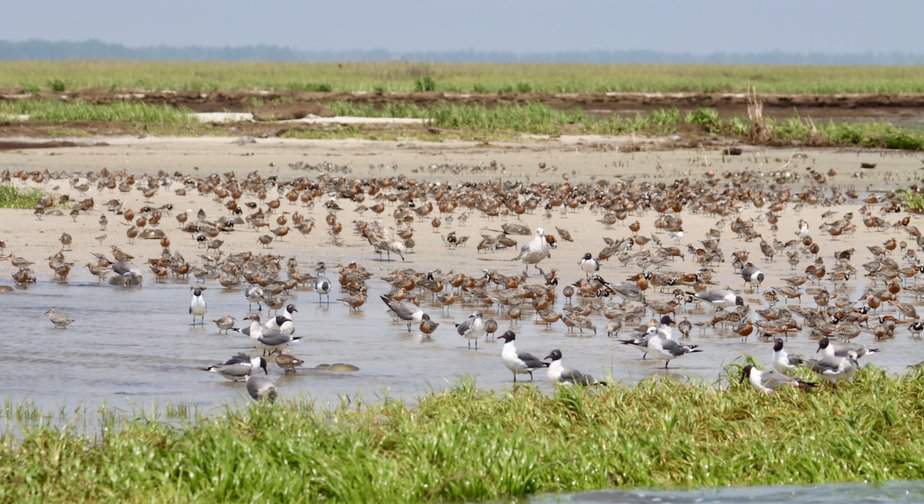
Red knots foraging on horseshoe crabs eggs along the shoreline of Egg Island NJ. We counted 2200 knots on June 1st.
By the numbers, the Delaware Bay Stopover for Arctic nesting shorebirds remains compromised and growing worse. Although the red knots numbers increased from 6800 counted last year to over 12,000 this year, that number is less than half the 2019 peak count of 30,000 and a fraction of the population in the 90s. In our first catch of the season, we found red knots averaging about 105 grams or 20 grams lower than their fat-free weight, so they burned muscle to get here. But by the third week of May, egg densities had only reached about 7000 eggs/sq meter, well below the 10,000/sq meter seen in recent years and far below the 50,000/sq meter seen in the 1990s before the overharvest of horseshoe crabs.
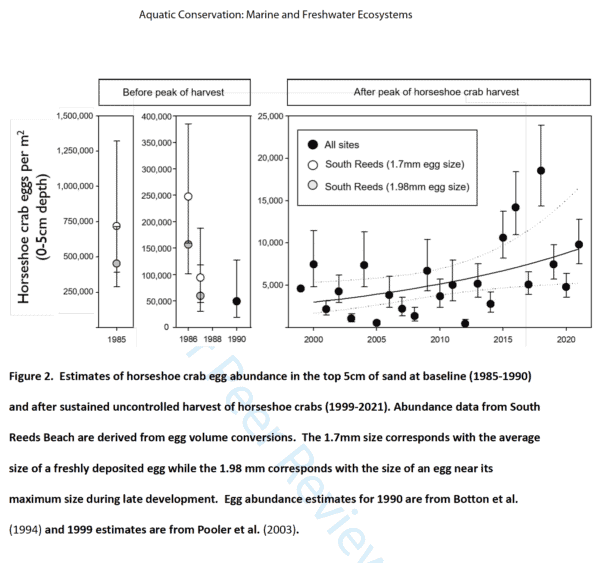
A graph taken from Smith el 2022, a paper on the history of horseshoe crab egg densities on Delaware Bay since the first egg surveys
To understand why the stopover is declining, we must take the bird’s perspective. Remember the most threatened segment of the red knot population, those birds wintering in Tierra del Fuego, South America, must shrink their stomachs to add more fat for the 7-day nonstop flight across the Amazon Basin and the Atlantic Ocean to get here ( see this attached geotag flight map). On arrival in Delaware Bay bay, they cannot digest their typical prey of clams or mussels and must have eggs. At first, they use eggs to rebuild muscle and restore their shrunken digestive system. Afterward, they build weight for the final leg of the flight to the Arctic, all in about eight days.
In late May this year, we caught red knots weighing 223 grams or nearly 100 grams above fat-free weight. The birds are so fat they walk like babies with full diapers, the fat hanging from the lower abdomen. They are extremely vulnerable both when they arrive and when they leave. They’ve always depended on the bay’s superabundance of eggs to get fat quickly and leave the bay before any avian predators show up during the shorebirds’ brief period of vulnerability.
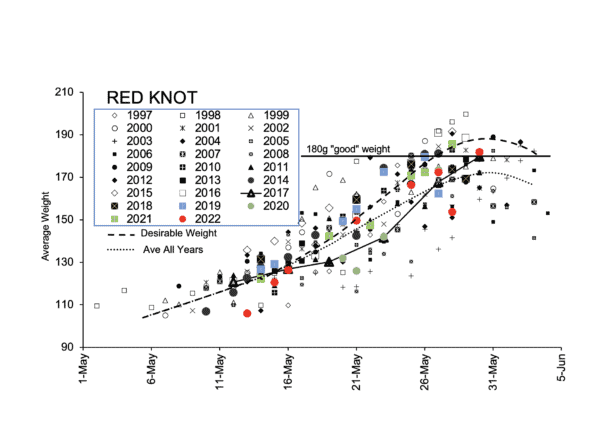
This graph shows the average weight of all catches of red knots made on Delaware Bay 1997-2022. We try to catch every 3-4 days during the stopover period May 12-June 1.
Instead, they now find a spotty distribution of eggs, and an artificially supported peregrine falcon population attacking them wherever plentiful eggs occur. The eggs are spotty because the ASMFC sanctions the killing of over a million crabs each year directly by bait fishers and multinational pharmaceutical companies and a million indirectly by clam/scallop/oyster dredgers. The killing has reduced the peak of spawning from a plateau that covers weeks to a peak covering only a few days. Many highly suitable beaches for crab spawning are barren of eggs for most of the month. The patchiness of eggs concentrates foraging birds, too fat to resist the attacks of Peregrine feeding their young. Unseasonably cool bay water exacerbates both threats by shifting the peak of egg-laying later in May instead of mid-may when the birds need them. So the resources on the bay are no longer reliable to the birds, and the birds vote with wings. Our satellite transmitters show the birds bypassing the bay. The Delaware Bay stopover is dying.
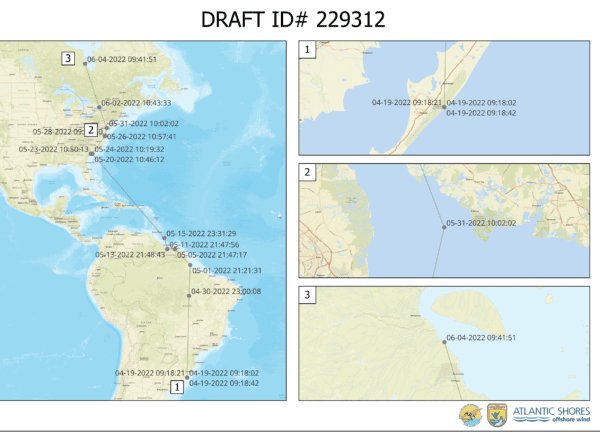
This red knot with a pinpoint satellite transmitter attached in Lagoa de Piexe Brazil flew to South Carolina then to Virginia before arriving in Delaware Bay. It stayed only a few days in Delaware Bay before moving on to Canadian Arctic. The bird used other stopovers to get the weight it needed and not Delaware Bay, a sign the bay is no longer dependable, a key aspect of the bay stopover that is lost.
The reason for this eyes wide-open destruction of one of the most important natural features in the US is not complicated. Simply put, the agencies allow the killing of too many crabs leaving only enough to spawn when sea conditions are perfect, and then blame the less than perfect conditions for the collapse of the stopover. If crabs were allowed to recover to historic numbers, birds would have abundance in any conditions.
But the justification for this destruction of the Delaware Bay stopover comes from fishery biometricians who have almost no field experience, use little of the data collected each year to assess conditions, and instead rely on mathematical models to describe a reality that few biologists fully understand. The biometricians ignore the aerial and ground count of red knots showing that numbers in the stopover have declined from a high of 93,000 to 6800 last year because modeled estimates declare a virtual population of 43,000 knots. No one has seen 43000 knots on Delaware bay since the 1990s. The biometricians also don’t rely on the at-sea trawl they created to track progress towards the recovery of the crab population. Instead, they chose the data from finfish surveys that show increases. The dedicated trawl of horseshoe crabs has shown no increase in the 20-year survey, yet the biometricians have declared the population recovered. The biometricians also ignore 30 years of egg density data. The egg data has shown no increase since its collapse in early 2000. At one time, there were 50,000 eggs/square meter on the surface of Delaware bay beaches in May; this year, there were about 7000 eggs/square meter in May. Biometricians get to ignore all this history, and we must take it on faith they know more than we know.
They also get to ignore their record of success. We compared the success of fishery management by the same biometricians with their Pacific coast counterparts. Only a few of the 112 fish and shellfish managed by the Pacific Marine Fish Council are overfished and those are closed until recovery. In contrast, nearly all the fish managed by the ASMFC are overfished or depleted, and all have open harvests.

A comparison of the species managed by the Atlantic States Marine Fish Commission and its Pacific Coast counterpart
Two actions must take place to restore the Delaware Bay stopover for red knots and other shorebirds. Stop killing Delaware Bay horseshoe crabs until egg densities reach average densities of over 50,000 eggs/square meter in suitable habitat, and remove all Peregrine falcon nests from Delaware Bay and the southern NJ Atlantic Coast. Peregrines have made a remarkable recovery from their population crash due to DDT use and no longer need artificial nesting sites along the coast in order to thrive.
On a final and more positive note the knots on which we attached transmitters are now on their way to the Arctic, several already on Victoria Island and Baffin Island. The results from the new solar-powered Sunbird Satelite Transmitters by Lotek are stunning and a wonderful reminder that migration persists against all the odds because of the good work of all the people helping birds and crabs.
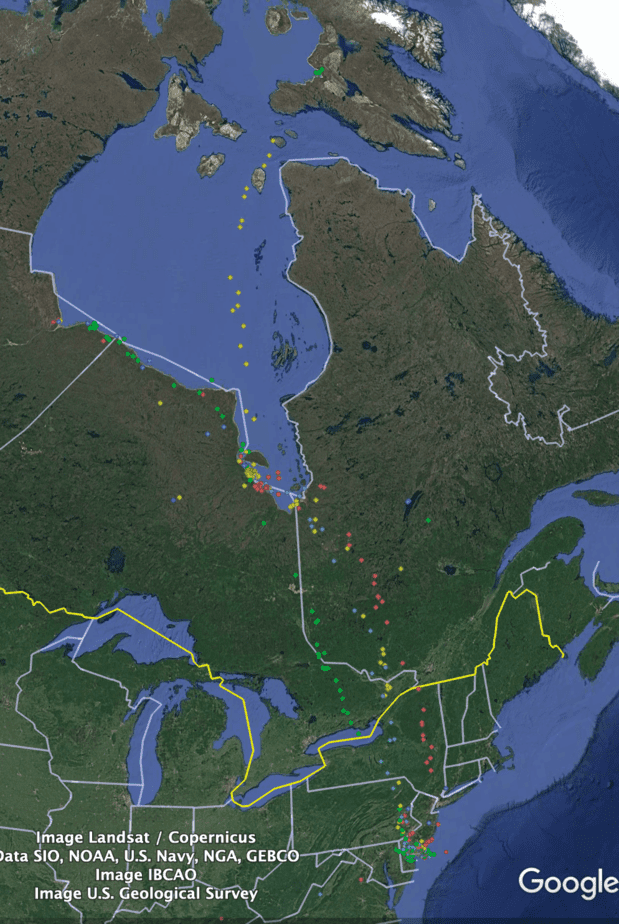
Each color dot represents a different knot starting with a massive cluster in the bay and strings of locations to the Hudson Bay and North.
Larry Niles
—

