Previous Post
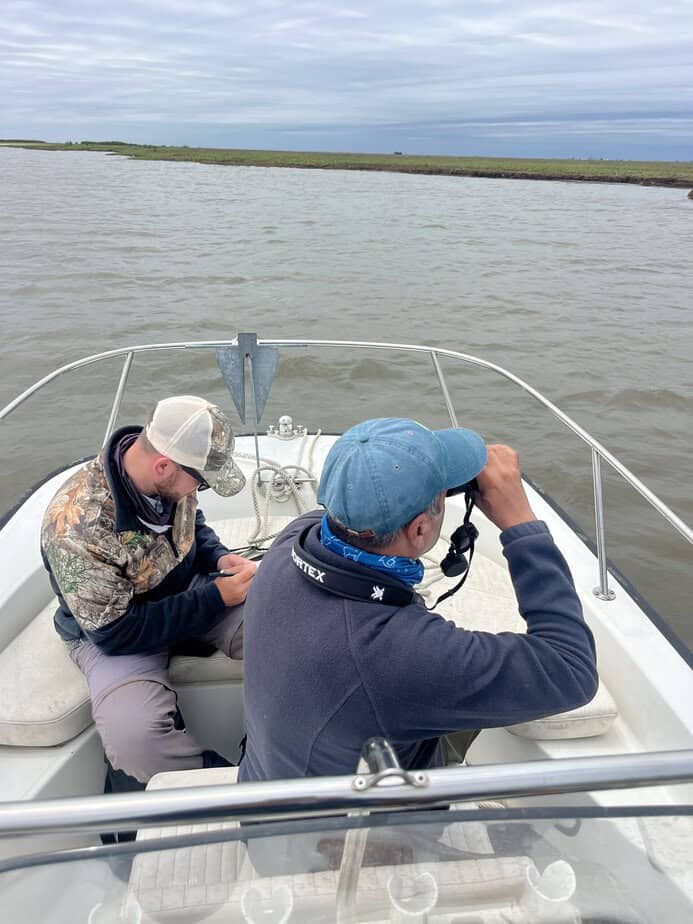
Antonio Brum and Mateus Haas survey shorebirds at Egg Island NJ
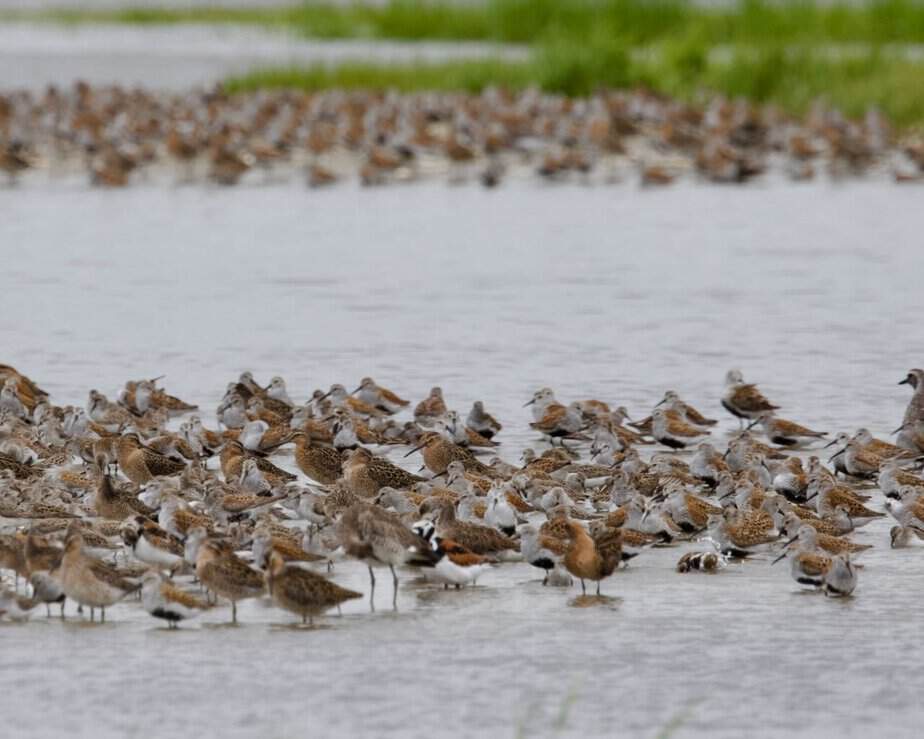
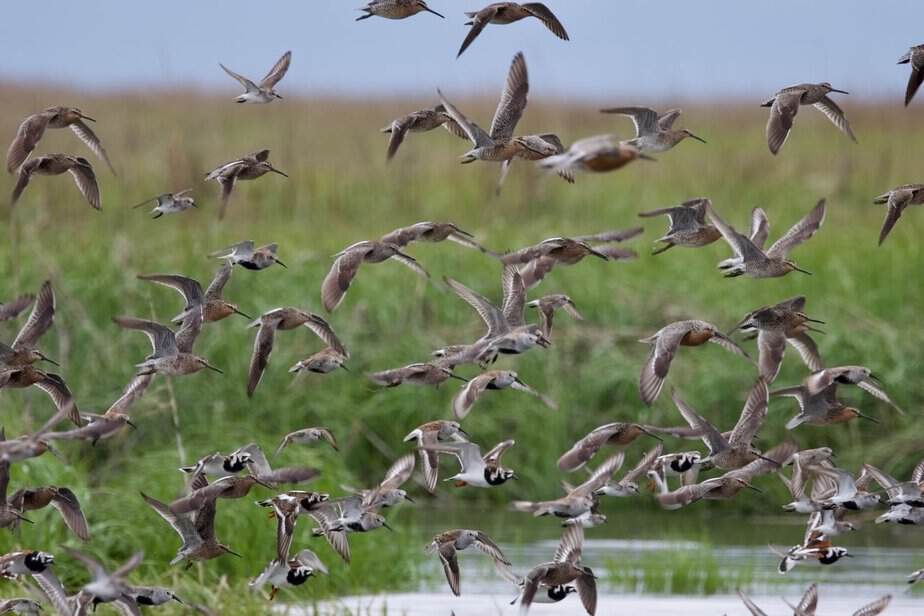
Yesterday (May 22nd), we conducted our first ground, boat, and aerial survey of shorebirds along all of NJ’s bay coastline. Our team counted 26,626 red knots, 25,360 ruddy turnstones, 10,015 sanderlings, 90,087 semipalmated sandpipers, 60,497 dunlin, and 1078 short-billed dowitchers. The Delaware ground count and NJ Fish and Wildlife aerial count have not been reported, but we heard through the grapevine that 2000 knots were seen along the entire Delaware shoreline. We also counted at least 37,369 laughing gulls.
These results are slightly higher than last year and within the margin of error for counts. Still, it generally continues the upward trend for all species if we include the estimated number of knots in Delaware. In 2025, we counted 25,654 baywide, and this year, 28,626 red knots. Ruddy turnstones in NJ also increased, from 21116 to 25,360, but without the DE count, we don’t know to what extent.
Nearly all the knots were just north of Reeds Beach, between Moore’s Beach and Bidwells Creek. Stephanie Feigin and Alinde Fojtik, in a boat captained by Shane Godshall with the American Littoral Society, counted most of the red knots in their survey from Bidwell’s to the Maurice River. 12,000 knots were counted between Goshen and Dennis Creek, and another 10,000 between West Creek Moores and Thompson’s Beach. Antonio Brum, Mateus Haas, and John Bloomfield, in a boat captained by me, found a total of 150 knots in the entire area from the Maurice River to Fortescue, including Egg Island Point, where previous counts recorded as many as 16,000 knots. Although most of the red knots were on the inaccessible beaches our ground counters saw several thousand on South Reeds, Cooks, Kimbles, and Pierces Point beaches.
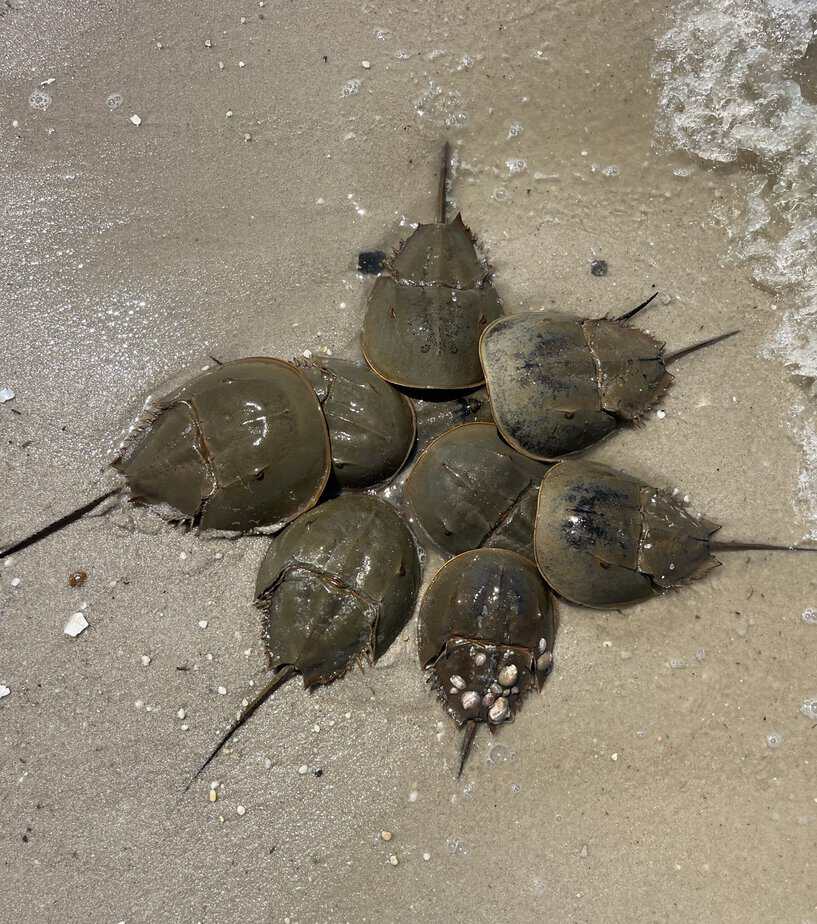
Equally remarkable, Susan Linder and her team surveyed some of the densest egg densities in recent years. The data is still but on some beaches egg densities went from good (11000 eggs) to great (19,000 eggs per square meter). This is good news for everyone who cares about the health of the Delaware Bay ecosystem.
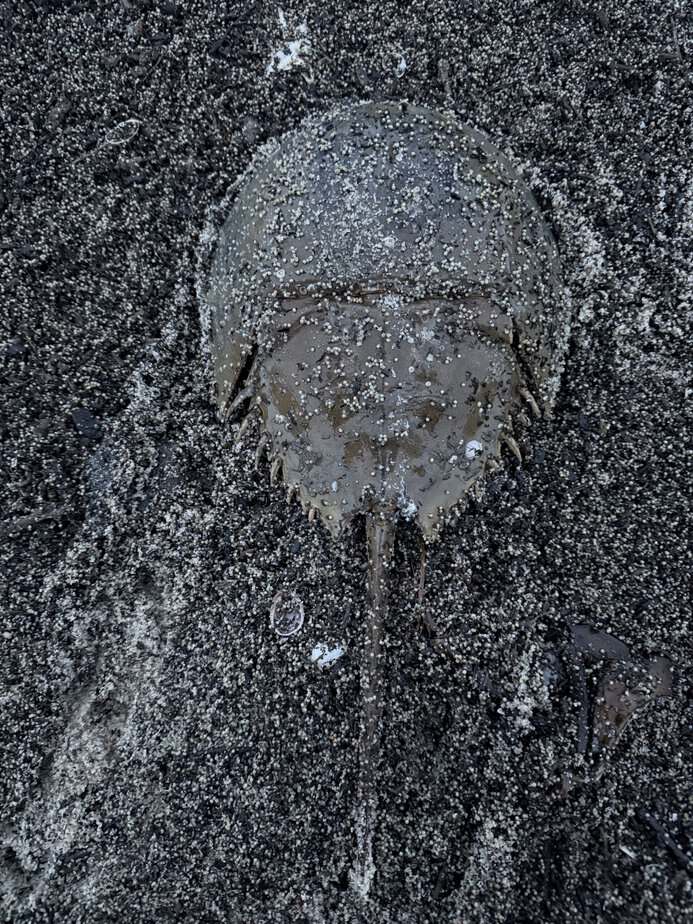
Horseshoe crab covered in eggs at North Reeds Beach. Photo by Jay Bolden
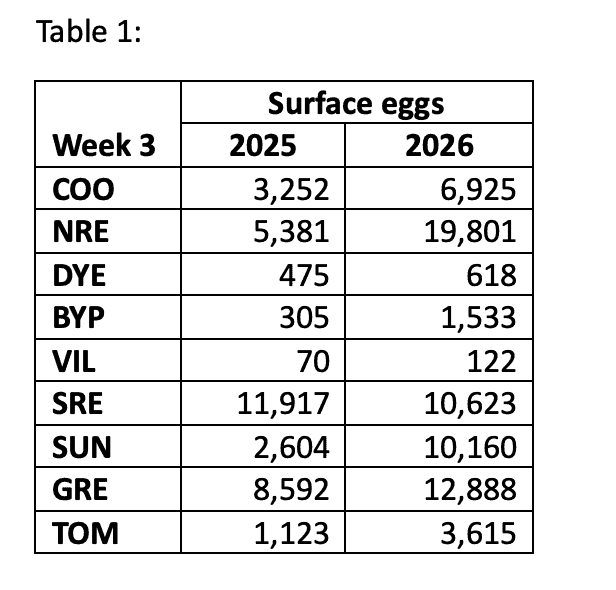
Surface densities of Horseshoe crab eggs on NJ Beaches. North Reeds was highest at over 19,000 egg/ square meter. The numbers were generally higher than last year at the same time. Table by Susan Linder
Why have we seen more birds this year? In part, it is because the TDF wintering count increased from 14000 to 18000, according to a survey conducted by Ricardo Mateus, who has conducted the count for most of the years since Guy Morrison retired from the survey. The number is also the highest in recent years, and it represents a true win because the long-distance winterers who were hit the hardest by the decimation of Delaware Bay overharvest of horseshoe crabs.
So our high count is in part due to the growing wintering numbers in TDF. Another reason for the increase and the majority on NJ Beaches is how we manage our beaches for the birds, with good protection from disturbance and restored beaches with sand grain size that promotes dense hc breeding. So at least part of the reason for our big flock is a genuine rise in the number.
But I offer a second hypothesis. When the bay’s shorebird population crashed in the early 2000s, it was caused by two threats. The first was a true decline in shorebird numbers, best illustrated by a survey of shorebirds flying south from the Arctic through the Canadian Maritime Provinces. Canadian agencies are less likely to bend facts to facilitate the bleeding and bait industries. The chart shows how decimated the 6 species that come to the bay are: red knots, short-billed short billed dowitchers, dunlin, semipalmated sandpipers, and sanderlings, to varying degrees. These are real losses.
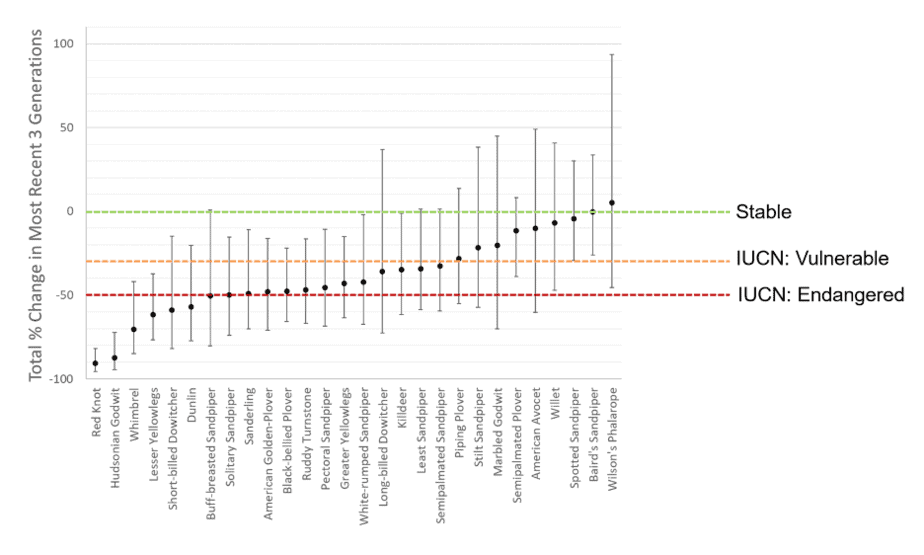
Environment Canada conducts extensive surveys throughout the Maritime Provinces to estimate shorebird numbers and trend. Here are the results showing all six of the shorebirds that come to the bay are endangered or threaten with little change in thier status. See paper here
But the bay’s numbers are not only a consequence of declining or rising populations because they also reflect birds that stop coming because of poor egg densities. We found in our studies of knots with satellite transmitters that if a stopover declines in quality, knots and other shorebirds will find another place to stopover. There is a limit to this, of course, because the birds’ normal diet of clams and mussels is far lower in spring than in fall, so the entire flock becomes resource-limited. Birds may not breed, and some might die, but most live for another season. If eggs return the following year, fewer birds will arrive, but if eggs persist the number will go back up the following years.
This happened in 2020 when the crab spawn was delayed by cold weather during the COVID years. Unlike most agency folks we continued our field work and found absmal egg densities because of cold water. Red knot numbers plunged from about 18,000 in 2020 to 6000 in 2021. But the spawn was good in 2021 despite the low numbers, so in 2022 the flock grew 12114 knots and then to 22,202 in 2023. In other words the impacts of low egg densities are not see in the shorebird numbers until the following year. We had a decent spawn ( still nothing like the 50,000 eggs/ square meter in before the overharvest) but enough for our diminished shorebird numbers. But to grow the population we need to stop the killing until the crab population is fully recovered – as measured by egg abundance.
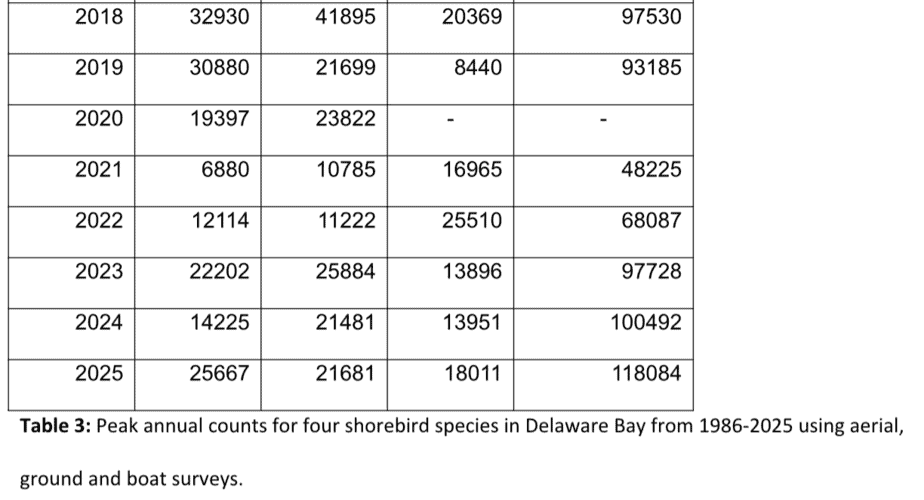
In 2019 and 2020 horseshoe crab spawn was delayed by cold weather forcing many to leave in diminished condition. The spawn in 2020 nearly failed completely. The following year all but 6880 red knots returned. Since then numbers improved steadily because of increasing egg availability during the stopover period. Agency biologists misinterpret this essential data as variation instead relying on untested statistical estimators based on resightings.
Right or wrong, the US agencies don’t care about the quality of the Delaware Bay stopover, such as the density of horseshoe crab eggs. Their measure is a sampling survey off the Atlantic Coast that generates numbers with wide error bars. Thier only guiding principle is to kill as many horseshoe crabs as possible without harming the red knot, only one of 6 species using the bay. But the metrics they use to assess impact don’t capture the real impact to shorebirds – the amount of food available to them – and they refuse to change.
So what everyone who cares about crabs and birds has to worry about amid all this good news is that the agencies will now try to increase the kill of horseshoe crabs. The justifications are absurd. The species caught with dead crabs, whelk and eels, are severely overfished, and a clam bellies and invasive green crabs are better anyway. The multinational companies bleeding horseshoe crabs for lysate will almost certainly try to bleed more crabs, even though they all sell various synthetic alternatives to lysate taken from crab blood. These syntetics are already approved by the US Pharmacopeia and now used by many pharma companies like Ely Lilly. The blood companies make more money on the blood so they fund a whole network of conservation groups to spread disinformation about the impact of their bleeding operations.
But for us people who care about the stopover, our goal is to restore it to its original glory. Millions of shorebirds, rather than thousands, and egg densities that saturate bay beaches. The good news about the bay will be short-lived if we relent in our efforts to improve it.