Previous Post
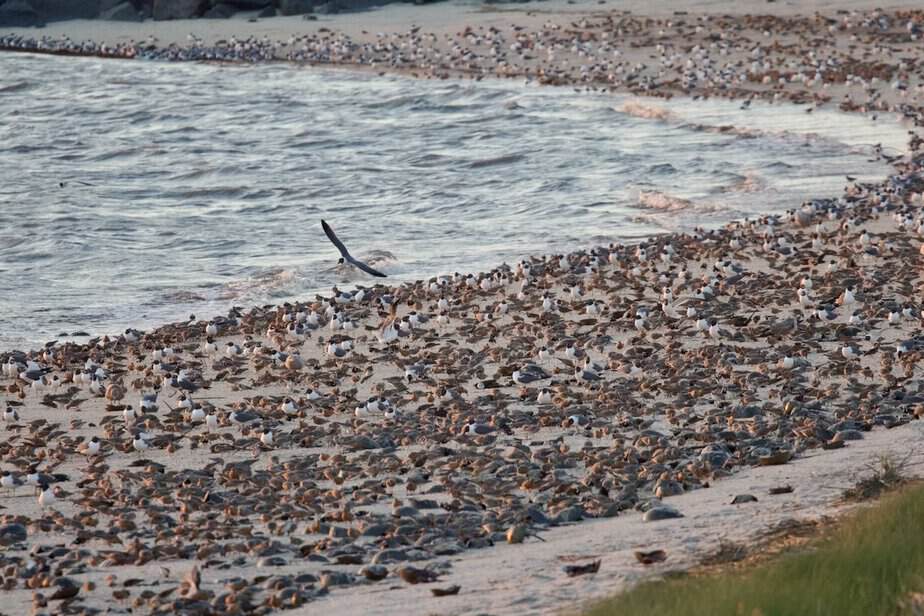
A portion of a 5000 shorebirds flock, mostly red knots, foraging on horseshoe crab eggs on North Reeds Beach NJ.
The True Value of Horseshoe Crab Eggs
Our research on shorebird stopover in Delaware Bay usually begins when we attempt first catch of birds on May 13th. But this year has been unusual from the start. Bay water temperatures hovered near the threshold required to trigger horseshoe crab spawning, and the result was one of the lowest egg densities we have seen in years. Our daily early-morning surveys counted roughly 3,000 red knots and a similar number of ruddy turnstones, but the weights from our first catch told an story of desperation: red knots averaged around 112 grams, well below what we expect at that point in the season. Fifteen birds weighed less than 100 grams.
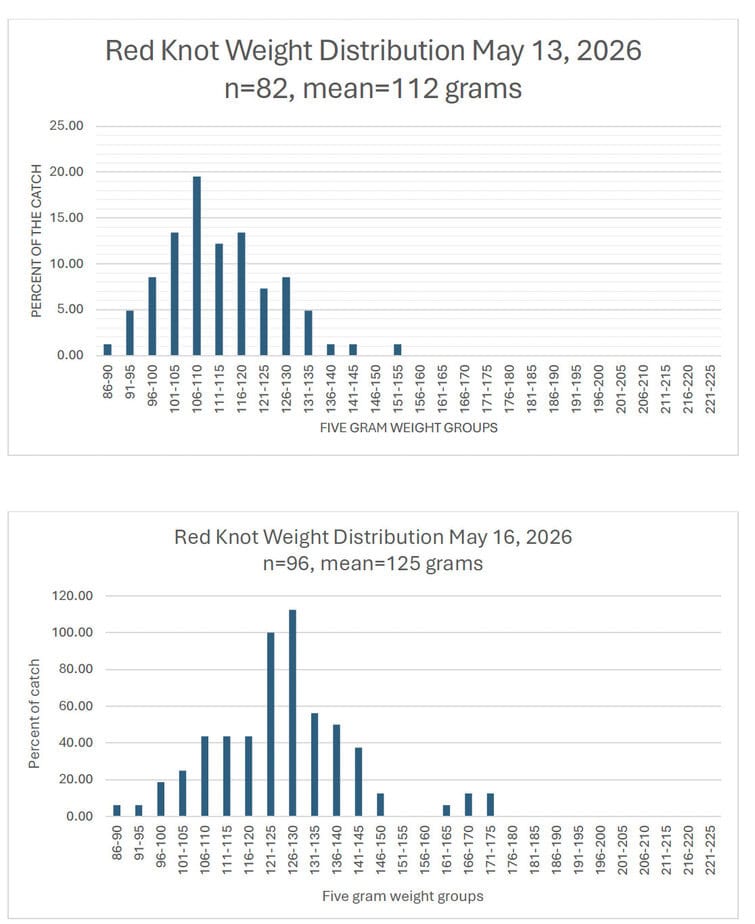
Red knot weights in our first two catches of 2026. Fat Free weight for the knot is 125 grams, so many of these birds burned muscle to get to the bay. Histograms by Stephanie Feigin
Our second catch was nearly identical confirming the grim prospects for two reasons: the near absence of horseshoe crab eggs on the beaches and their critically low arrival weights. These birds prospect were grim for two reasons: The near absence of horseshoe crab eggs on the beaches, and critically low arrival weights. Comparing our May 13th catch this year to the same date in 2025, the difference was stark — an average of 112 grams in 2026 against 140 grams in 2025, a 28-gram gap that is biologically meaningful for a bird that must more than double its weight before departing for the Arctic.
In the urgency of getting a large field effort underway, we sometimes move past what arrival weight actually tells us. It is, in many ways, the most important single variable in the stopover. The weight at which a bird arrives largely determines how quickly it can rebuild condition once it reaches the bay. Low arrival weight means a longer recovery time, which means a tighter window before the birds must depart for breeding grounds where timing of arrival determines reproductive success.
The causes of low arrival weights are largely beyond our control — and beyond the birds’ as well. Inadequate resources at southern stopovers can be a factor, but birds rarely leave those staging areas before reaching what they assess as a viable flight weight. More often the culprit is wind.
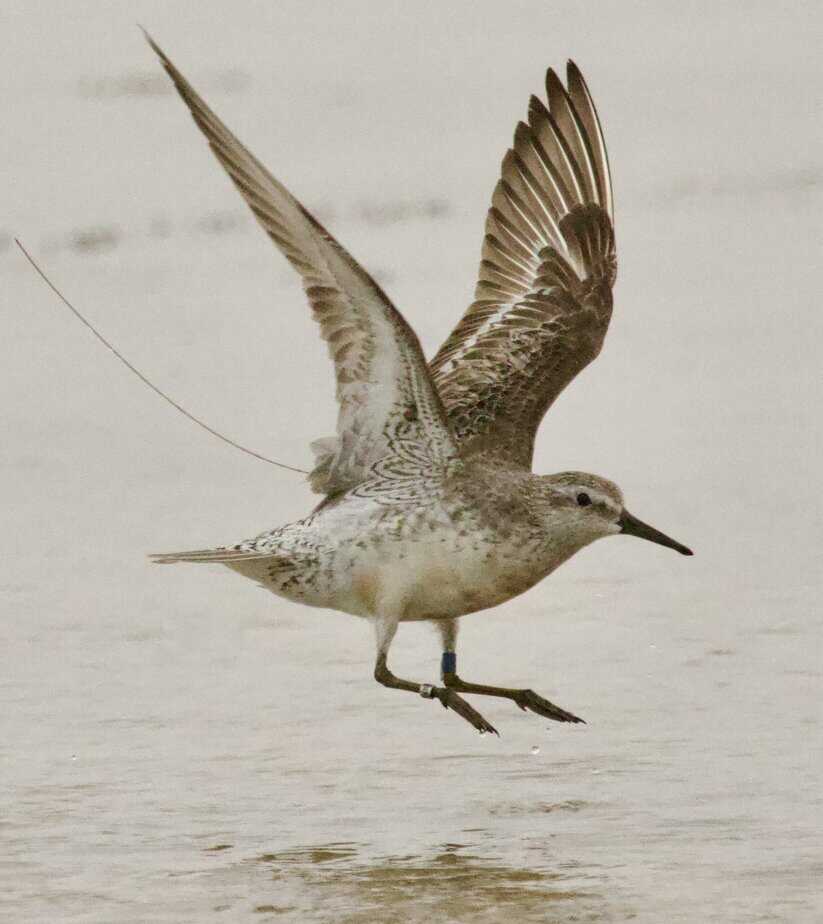
A red knot with a satellite transmitter in Lagoa do Piexe National Park in Brazil
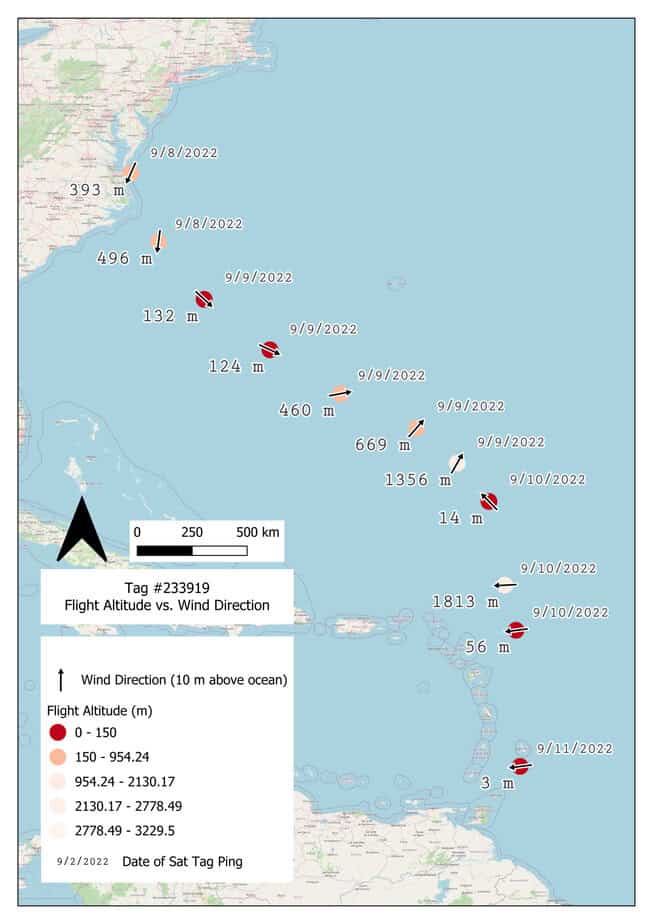
These two maps show the flight of red knots tagged with satellite transmitters flying south from the NJ Coast. Each include the altitude of the bird and the direction of the wind the bird was facing. Red dots indicate opposing winds. It shows the birds moving up and down during their flight trying to find the most favorable wind. Sometimes the cant as it appears in this years weight charts. Altitude is in meters. Maps prepared by Theo Diehl
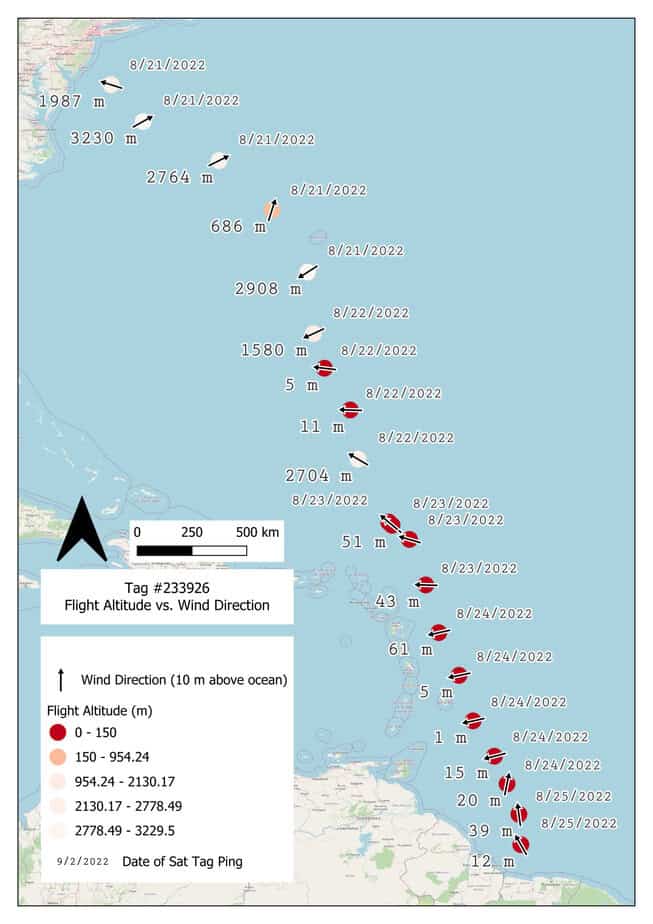
The birds cannot know what winds they will encounter once airborne. We have tracked red knots leaving southern Brazil and flying for seven days without landing, climbing to 10,000 feet or dropping to sea level in search of favorable conditions. A tailwind will make their journey easier; a headwind will make it tortuous. This year, judging by their weights, they encountered the worst of it. Arriving at the bay ahead of the crab spawn — when the eggs that should greet them are simply not there — compounds an already difficult situation.
Red knots weigh approximately 125 grams when carrying no migratory fat. Shorebirds typically manage their fat carefully, balancing stored energy against the increased vulnerability that extra weight brings — a heavier bird is a slower bird, and the peregrine falcons, Cooper’s hawks, and other predators along the flyway will know the difference. When red knots arrive at 112 grams or below, they have not simply arrived lean. They have arrived having burned muscle to complete the flight. The birds that reached us this year had muscled through conditions that stripped them below fat-free weight. That is a meaningful physiological deficit.
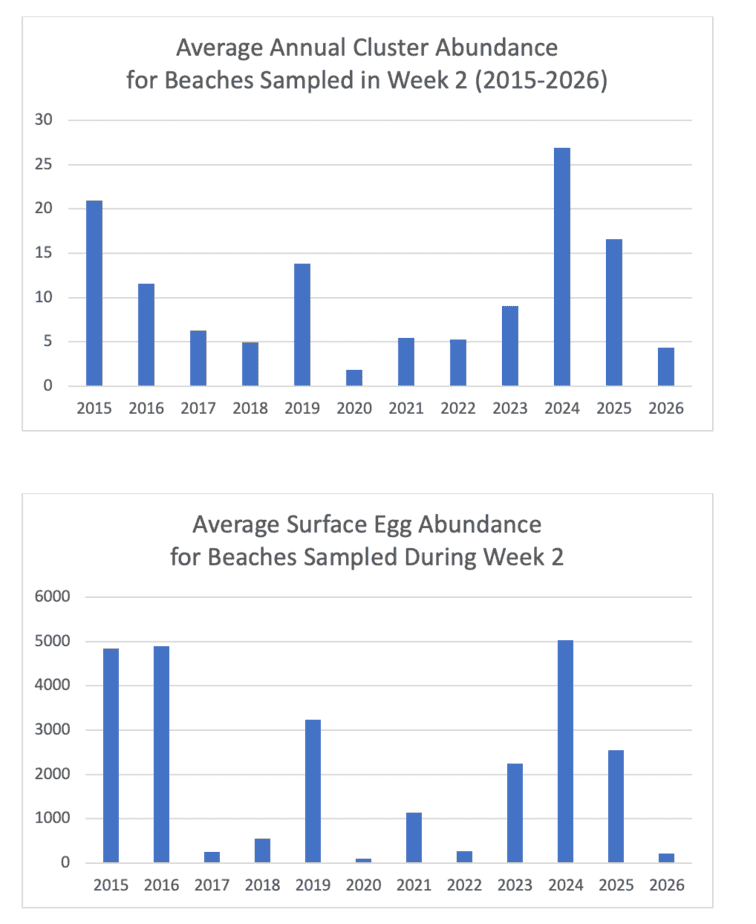
These graphs show the slow start for horseshoe crab spawning in NJ compared to previous years. Histogram by Susan Linder
Then, on May 16th, everything changed. Bay temperatures finally crossed the horseshoe crab spawning threshold, and three days of intensive daytime and nighttime spawning followed. Egg densities rose from near zero to 32 clusters per square meter — approaching the 38 clusters per square meter we recorded at the same point in 2025, and close to what we now consider a “normal” density for recent years, though far below what historical surveys documented in the 1980s. Surface egg densities jumped from 100’s/ square meter to over 11,000/ square meter.
The birds responded almost immediately. Our next catch of 175 knots on May 18th showed the birds were averaging 153 grams — a 32-gram gain from the first catch, and 15 grams above what the red knots weighed on the same calendar date in 2025. In the space of a few days, the birds had begun their recovery. Dense crab eggs made that possible. Nothing else did.
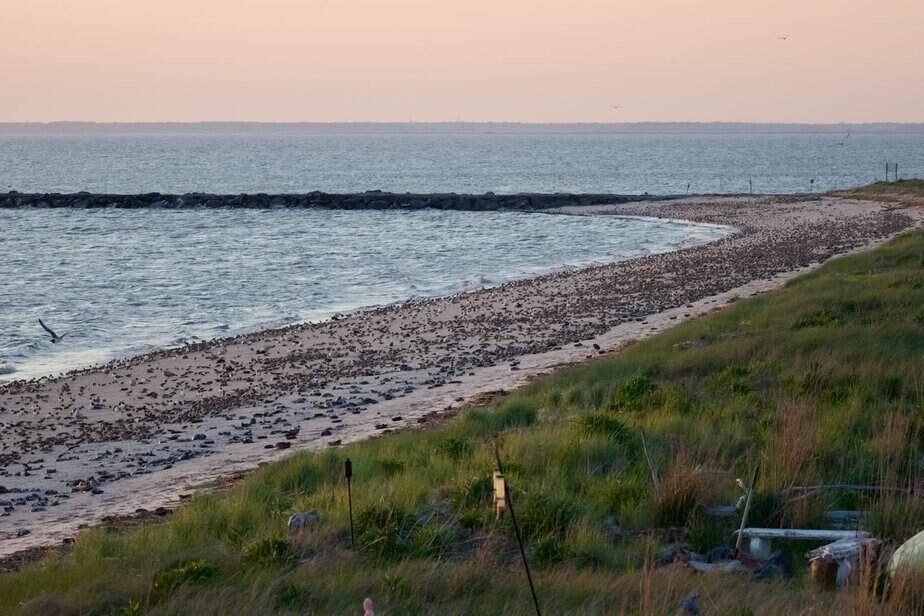
Red Knots on Reeds Beach north foraging on newly abundant eggs late into evening.
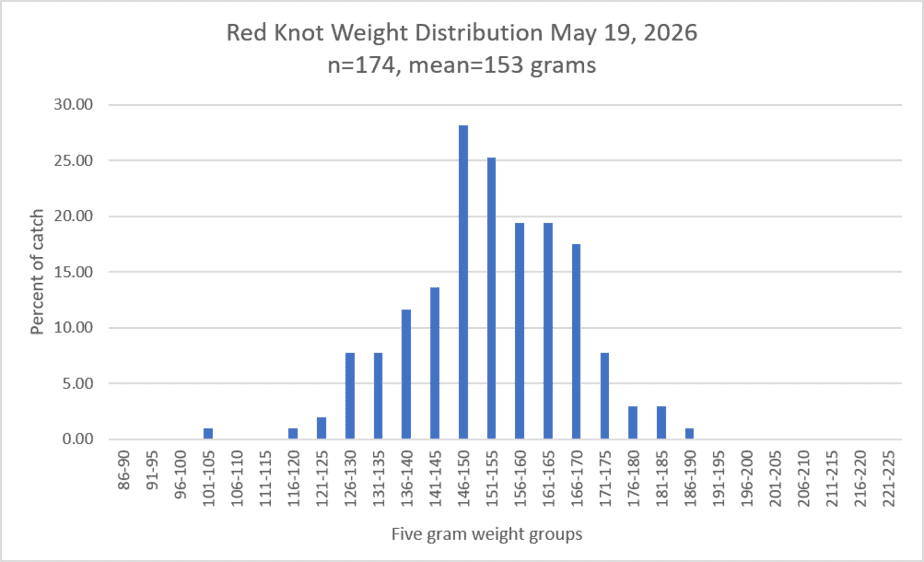
This graph shows the weight distribution of the red knots we caught on May 19th showing the dramatic weight gains by the same birds who averaged 112 gram only 5 days earlier.
What thirty years of field work on Delaware Bay has taught us, and confirmed again this spring, is that egg density is the central variable in shorebird stopover quality. It is not a complicated message.
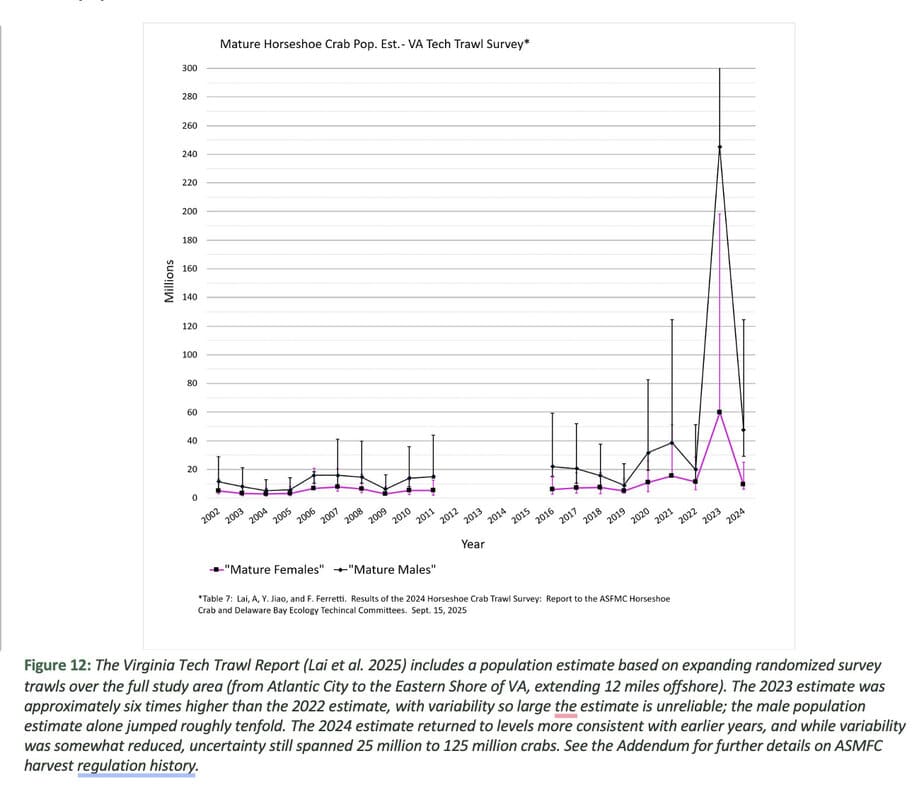
Fisheries agencies, however, have consistently declined to accept it. Instead of egg density — the most direct and ecologically meaningful metric available — fishery managers rely primarily on offshore trawl surveys conducted by Virginia Tech to estimate horseshoe crab abundance. These surveys carry wide confidence intervals that would ordinarily prompt serious questions about data quality. That they are routinely accepted as the basis for harvest decisions, while egg density data collected on the spawning beaches are dismissed or ignored, reflects a regulatory posture that is hard to explain on scientific grounds alone.
The trawl survey is funded in part by at least two companies that profit commercially from horseshoe crab blood. Those same companies have systematically minimized public understanding of the mortality their bleeding operations inflict on crab populations — particularly on females, whose eggs are the resource at the center of this entire system. The state of Delaware does not collect egg density data at all. There is no justification for excluding eggs from the assessment of the impact of killing horseshoe crabs except that it interferes with their relentless effort to increase the kill for bait and blood. Better alternatives exist for both uses, yet fishery agencies still justify the kill. To see a fuller picture of these data here is our 2025 report on the years work.
Birds do not have the luxury of regulatory ambiguity. They’re just trying to live – and to reproduce. Each spring they arrive having gambled everything on what the bay will offer. This year, for a few days, the bay nearly failed them. When the eggs finally came, they responded as though their survival depended on it. Our data simply records what they already know.
Finally I continue to thank all the Conserve Wildlife Foundation beach stewards and Wetlands Institute’s Return the Favor volunteers who diligently tend to shorebirds and crabs on our side of the bay. Your work is paying off for birds, crabs and the people who love them.