Previous Post
4
We tried to catch birds for the next six days of our trip with no luck. There were many reasons. The rogue waves spawned by the offshore cyclone bedeviled us long after it moved away. We would set a net, move the birds to the net, and a wave would take it out. Or we would set the net way behind the waves and move the birds in front of the catch area where they would stay out of reach of the net set too far above them. With repeated failures to catch, we gradually found a sweet spot just high enough to miss most big waves and low enough to catch birds before the net flooded out.
Yet we still missed birds because of a problem with the cannons. As shown in the video below, the net kept going out too high, and birds would escape before it lowered to catch them. It took us some time to figure this out.
It had to do with how we set the cannons. The angle of the cannons is vital to ensuring bird safety while still creating the best chance of catching them. Set too low, the net is dangerous. Set to high, and all birds will escape. As in all other places we have trapped, I set the angle of the cannons using a simple procedure I learned from Clive to ensure that the projectiles and net go out at the same height whenever we fire.
First, one must consider the wind. It pushes the net down from behind, and it lifts it when from the front. To keep the angle constant, I use my eye and natural pace. Without wind, I pace four steps out from the cannon’s muzzle, knell, and adjust the cannon angle to match my sightline down its top. This way, I know the net will be high enough to clear the birds near the net set. If the wind comes from behind, I reduce my paces from 4 to 3, which raises the cannon’s angle. If the wind comes from the front, I increase my steps from 4 to 5, thus lowering the cannon. This way, the net goes out at the same angle, irrespective of the wind.
So why did the net go out high all the time? At first, we adjusted the cannons downward but cautiously because going out too low could cause harm. But no matter how low we set the cannons, the net came out too high, allowing birds to escape. Eventually, we saw the reason. Unlike our cannons with a welded base plate to resist the pushback from the cannons firing, Virginia’s cannons had only a spike on the bottom that inserts into a 12-inch diameter round plate of steel about 1/2 inch thick. When setting the cannons, we would dig a hole for the plate and cannons, similar to how we would dig in our cannons. But when fired, the wide plate held firm at the bottom, where it abutted firm sand, while the top gave way and tilted the cannon up so the projectile would go out high. We learned to set the plate first and hammered it into the sand to make a good base.
We also had to fire the net several more times with video to figure out how to extend the jump ropes that anchor the back of the net to the beach so that the net would go out further. We increased the jump ropes from about 6 feet to 15 feet and increased the charge to 27 grams to power the net through the more extended catch area. We did the same for the box net. With this change, we extended our catching area past our normal range from 10-12 paces to 13-15 paces. We learned as we went, and each new decision came from the team discussion, and Antionio executed all the changes to the cannons and net set, so he was prepared to continue after our departure.
After five days of failing to catch birds, we struggled to stay positive. Good food and drink helped. Each morning Julia provided us with fresh bread, yogurt, and eggs, allowing us to eat a hearty breakfast on our schedule. The ASI farm also offered solace. The cabins provided an easy living, more like home than the hotels in town. We could conduct our daily preparations for trapping – reloading charges for the cannons, charging transmitters and handheld radios, drying the net from the day before, and re-packing the trucks – with relative ease and comfort.
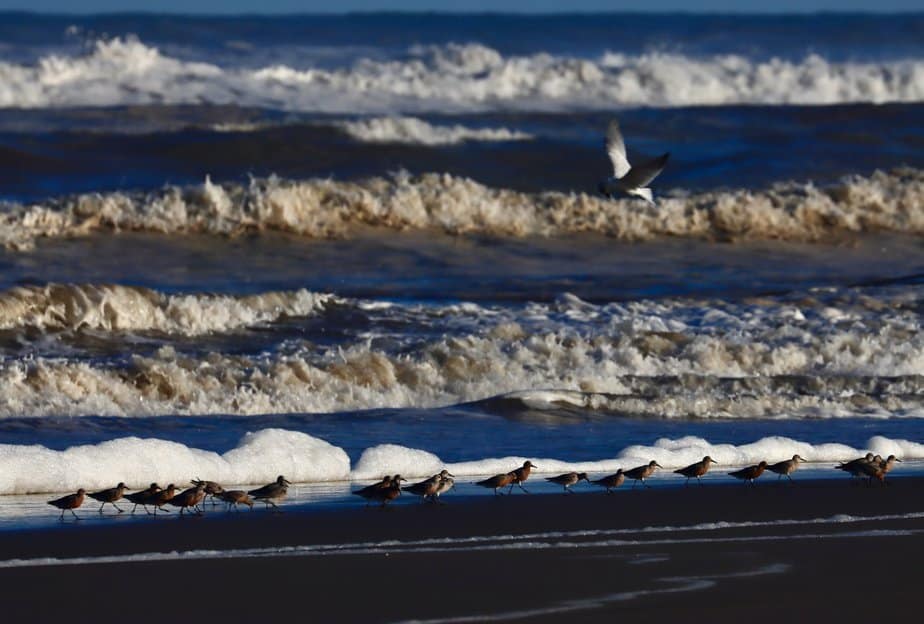
Meanwhile, Lori and Keith prepared lunches that brought relief during a tough day setting and resetting nets. Lori would open the cooler with sandwiches, and the entire team converged like shorebirds on dense clams, then retreated in small groups enjoying the sun or chatting about small things. We spent our days working hard, but our meals gave us a break to appreciate the good weather, a mighty dazzling sea, and a crystalline sky of deep blue and golden sunlight. And to be honest, even failing to catch brought us closer to understanding this wonderful place, the birds we sought to catch, and the unique communities of people.
I say unique knowing the people of LDP are no different than those in my community along Delaware Bay; we all struggle with life and death, enjoy family and friends and seek to make a living as best we can. But the circumstances couldn’t be more different. Rio Grande do Sol is mostly farmland and production forests except in the river valleys and the coast, where nature cuts short the designs of people with floods and storms. Nearly all land is in some form of production; even forests planted and grown for lumber are still tapped for thier turpentine-laden sap and grazed by cattle. So most people are tied to the land in one way or another. They are poorer, earning about half as much as NJ folks, and live more rural lifestyles, but I sensed a more significant difference.
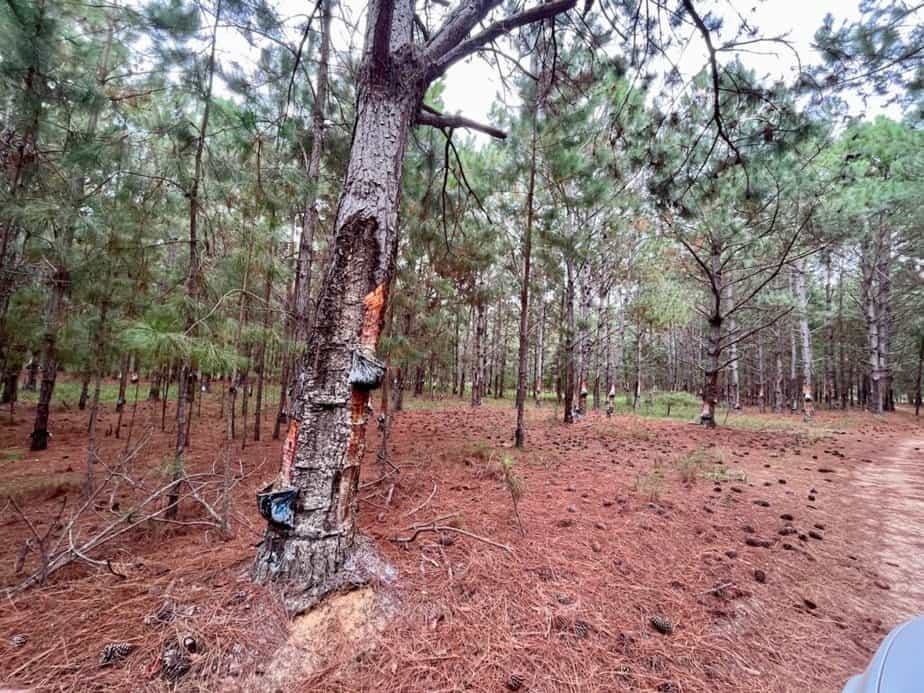
Most forest in the area of Lagoa do Piexe are heavily used, for timber, for sap and for grazing.
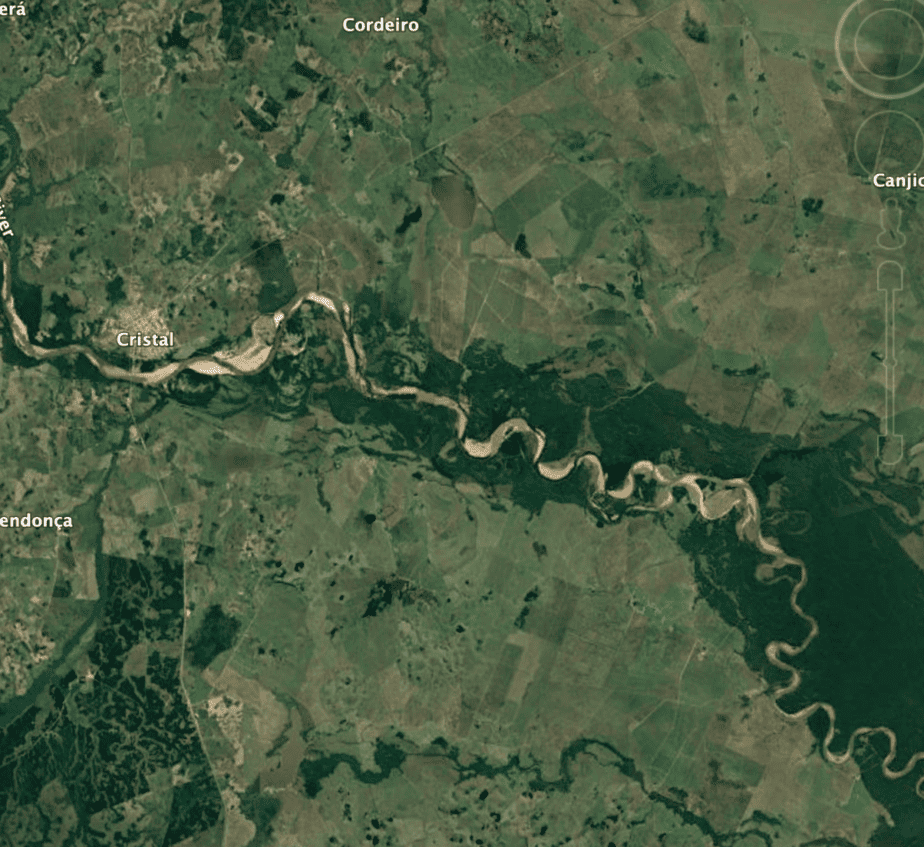
Nearly the entire landscape of the state of Rio Grande do Sul is managed for production . Most suitable areas are farmed or grazed. Land not suitable grows timber for cutting, and to make turpentine from the sap. Most forests are also grazed by cattle.
Perhaps, it’s as simple as the lack of guns. Most are outlawed except for small uses, like killing feral pigs. Does this change daily interactions when there isn’t this underlying threat? If these people are the same as those of us from the US, then why are all wild animals protected by law? Only exotics can be killed for recreation. Antonio, a lawyer before becoming a Ph.D. student in ecology, said, “There is little enforcement, so people still kill and eat wildlife, but few people do it openly and for recreation.” I know I am at risk of cultural arrogance, but I wondered if Brazilians are better Americans than us.
One night after a difficult day catching nothing but coming close several times, we decided to buy chicken and shrimp so Antonio could prepare his special meal. Instead of going to town, we went to a small community on the beachfront with sandy roads that appeared to flood on a good tide. Only one road connected the town to the mainland, a circuitous two path leading to another that, after 10 miles of weaving between gigantic dunes and wetlands, you reach the hard road and still must go about 5 miles to the nearest town. The place was remote. The town of about 30 houses surrounds one store, a ramshackle structure with two rooms, a bar, and a small food market with three aisles surrounded by mismatched freezers and refrigerators. Overhead fluorescent lights cast a dull greenish tint to the market and bar, where one man sat silently nursing a small glass of beer the entire 30 minutes we spent there.
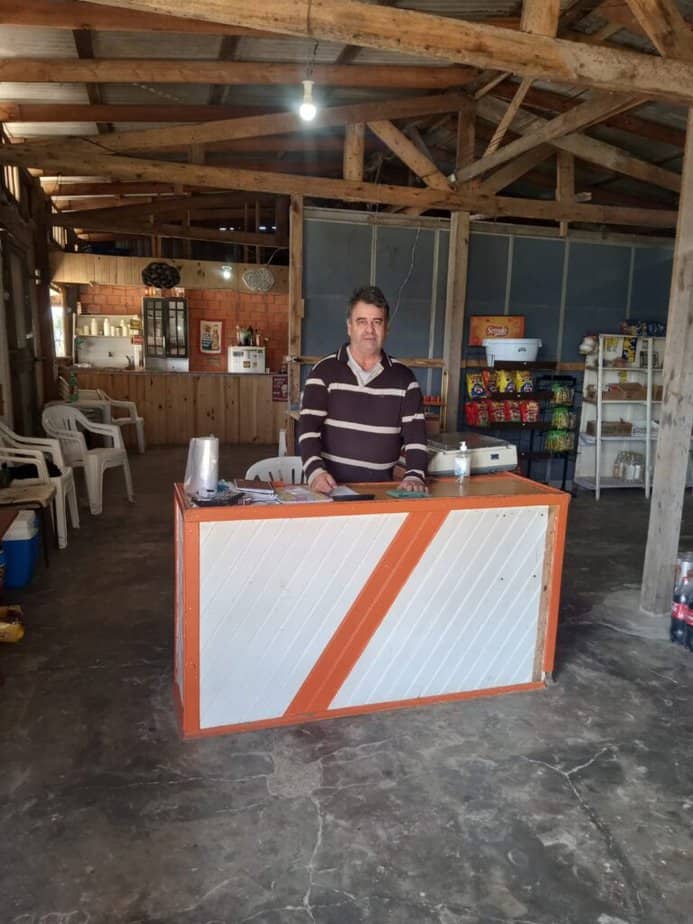
The shopkeeper at the Marujo market known as Carlinhos in Praia do Farol, Mastardas, Brazil
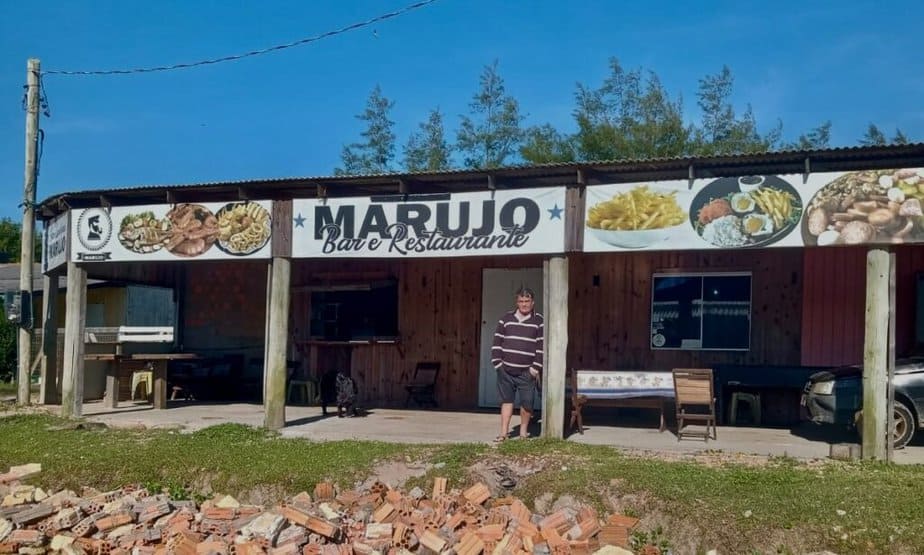
Marujo market in Praia do Farol, Mastardas, Brazil
As we entered, Antonio greeted the owner and his two friends. He knew them all from his previous fieldwork when he stayed in one of the town’s cabins, and they greeted each other with strong handshakes and hugs. He introduced me, but they knew an American was in the area and were curious. The three men were in thier 50s, wearing well-worn colorful tee shirts and all with a quarter-inch growth on thier faces giving them a somewhat gritty appearance. I guessed they had been drinking, so my guard was up. They couldn’t speak English, and I couldn’t speak Portuguese. Still, after my introduction, they greeted me with a cheerful “You are from the land of Trump.” They went on to describe thier support for Bolsonaro. This landed like a lead balloon for me. I live in South Jersey, where Trump reins ( our elected representative switched parties and gladly circulated his picture with Trump as a sort of f you to his Democrat electorate). I see Bolsonaro the same as Trump, so I was ready for verbal combat. I declared myself for Biden and waited for the usual crap I get from home. Instead, we continued our conversation about the birds, Avian flu, and other matters of more significant concern and interest. Over the next week, we went to this store to get supplies and each time the owner greeted me with warm enthusiasm, a handshake, and a hug. I couldn’t have felt more at home. In all my interactions with shopkeepers, agency staff, and colleagues coming and going from our project, I felt the same inherent warmth that made me repeatedly ask whether Brazilians are better than us.
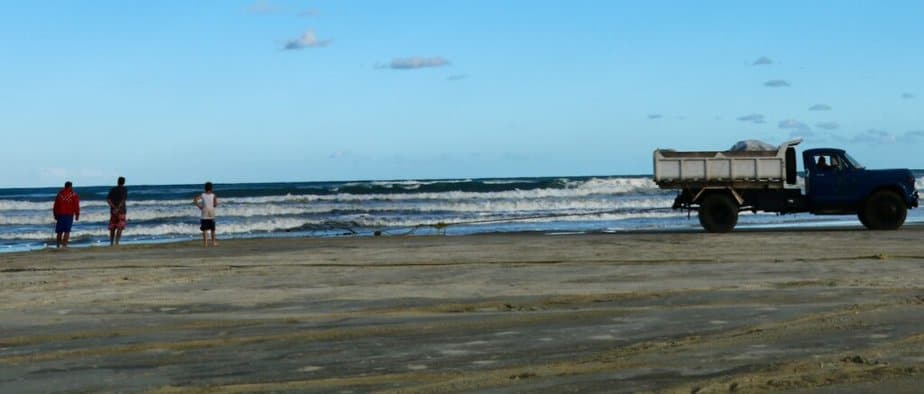
Fishermen hook the rope leading to a gill net to a truck to pull the net out of the water to extract fish. The net is anchored at the seaward side often set by men swimming or with an inflatable boat trailered out to the beach.
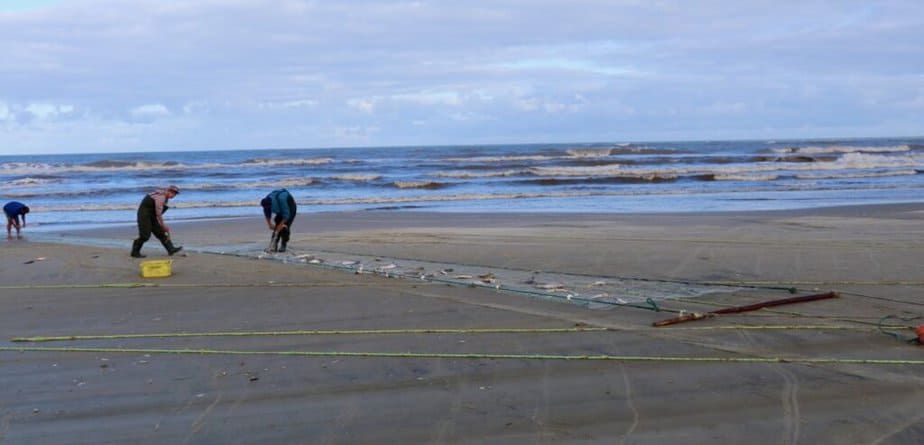
Fishermen extract fish caught in a gill net on Lagoa do Piexe Beach, Brazil
Each day was a variation of this basic pattern. First, a ride out to the beach, sometimes within the Park, on others 40 miles north near San Simeo. Then a slow ride down this beach which is like a few others. We past local fishermen using gill nets anchored to posts set in the dune and long ropes stretching into the sea. The other end of the net of about 70 yards was held fast by an anchor placed in the ocean, usually from a small inflatable, but sometimes by men wading out to water almost over thier head. A team of 3 or 4 men and boys return to the net the next day, hauling in the net, catching fish that will ultimately end up in the local markets and restaurants of the area. Some days, we would ride almost 60 miles and see less than 50 knots. We saw many other interesting birds, like a lone storm petrel stranded on the beach after battling the stormy seas offshore or a Magellanic penguin carcass washed ashore far from its home in Chile.
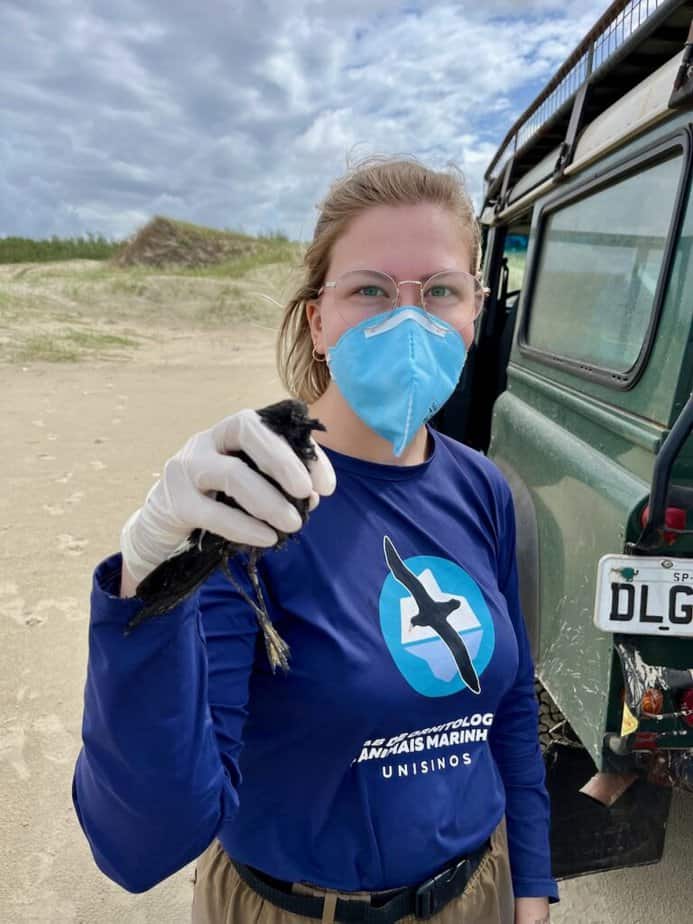
Victória Deecken holds a Storm Petrel, barely alive after surviving a storm at sea.
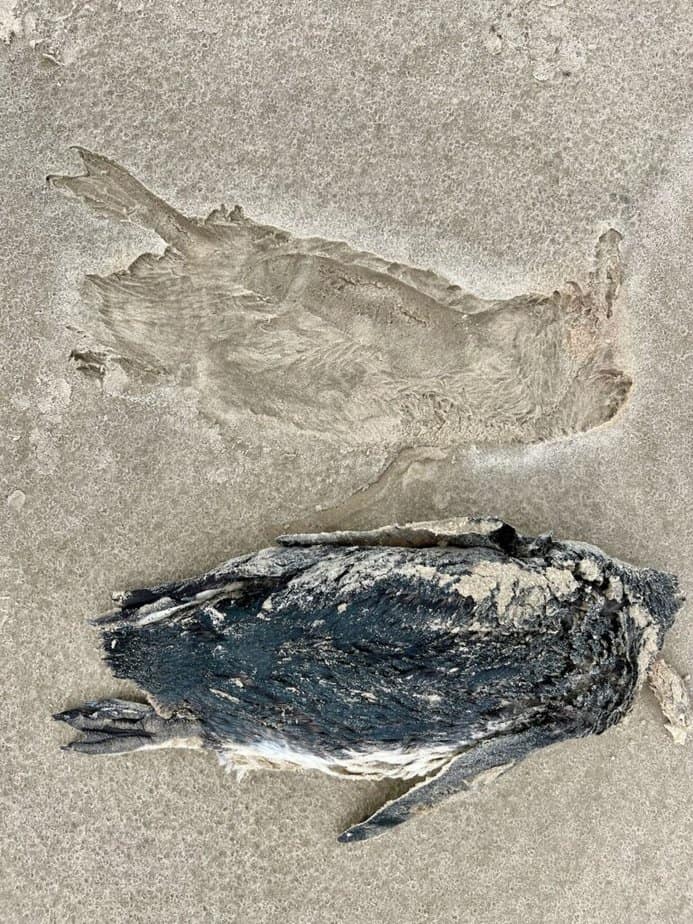
Dead or dying penquins and other species wash ashore on Lagoa do Piexe Beach when rough weather passes through the area. Because the the shoreline is at the junction of two major currents many different species can be found on the shore after a storm.
But as the days wore on and difficulties mounted, we found refuge in thinking about dinner and a beer. Some nights we cooked, like when Antonio and Mateo barbecued meat and vegetables on the indoor barbecue pit in one of the ASA’s outbuildings. On others, we ate out at one of the many restaurants in Mostardoes on our way back from the beach. Except for Keith and Lori, we all drank but got up early the following day to try and catch birds.
And then we did.
Next Post
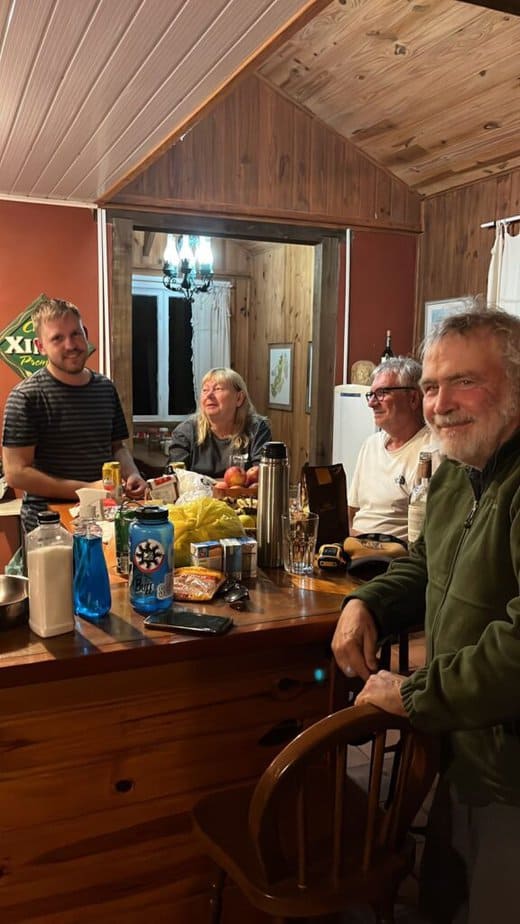
Dinners were very important during out trip, to help us wind down, discuss problems and the next days plans. Mateus, Virigina and her husband and Keith Talbot over dinner