
Previous Post
The Right Track
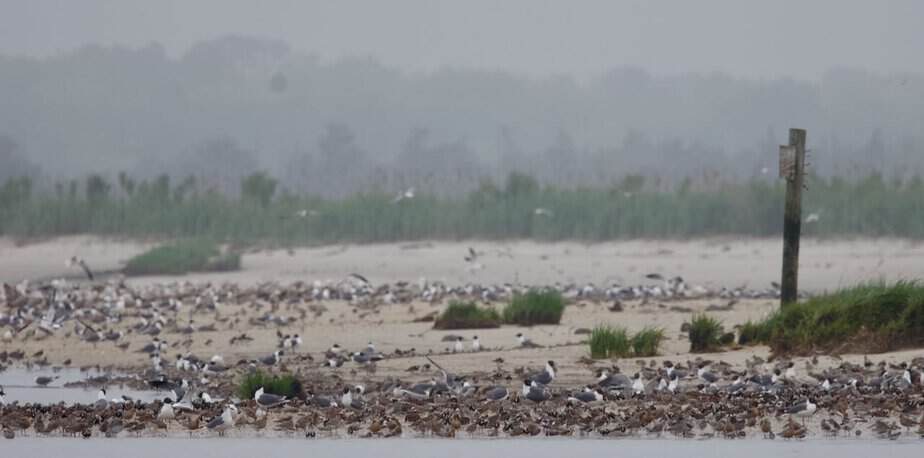
We sat on a low sandy rise above the small intertidal estuary next to Moore’s Beach, watching what had been a flock of 2,000 red knots and ruddy turnstones. As we set our cannon net, most of the birds fled. Undulations of semipalmated sandpipers were flushing and re-flushing constantly. The sky was overcast with no rain and only a breath of wind. We wore our bug jackets, but the no-see-ums were ubiquitous and persistent. We had hoped to catch a small portion of one of the largest flocks of red knots seen on the bay since the early days.
In my last post, I reported our peak number of red knots. But our ground and aerial count from the day before topped that. Our team counted 29,823 red knots on the New Jersey side of the bay. This was about 2,000 more than the last count on May 22nd, and 2,000 knots were on the Delaware side. Those birds likely have joined ours, giving us a record count.

Results of boat and Ground counts in NJ on May 22 and May 26 2026
In reality, the counts were within the margin of error, a testament to the skill of our counters. While ground teams covered the beaches, I piloted our only survey vessel, the Wildlife Restoration Partnerships’ Boston Whaler, which always draws attention from boat lovers. We moved slowly from Bidwell Ditch to Fortescue Creek, covering the remote, publicly owned marshes that make up one of New Jersey’s last true wilderness areas.
On board, four researchers split the counting duties. Stephanie Feigin and Phillipa Sitters focused on red knots, ruddy turnstones, and sanderlings. Meanwhile, Antonio Brum and Mateus Haas recorded semipalmated sandpipers, dunlins, and short-billed dowitchers, along with occasional sightings like local willets, American oystercatchers, and bald eagles.
We have been conducting this survey for all 29 years of the Delaware Bay Shorebird Project. I was also part of a count done before that, so my experience goes all the way back to the original count in 1981. During this time we have seen the wonder of more than a million shorebirds plunge to just 300,000 as fishers mindlessly slaughtered horseshoe crabs for bait. We watched birds come to the bay and leave without gaining the weight they needed to reproduce successfully. On one count, we watched in horror as the stopover teetered on the brink, with only 6,000 knots counted in 2020. But seeing the number of red knots and other species grow back to what we have seen this year is a message to all of us, biologists and volunteers alike – we are on the right track.
Heading North to Reeds
Having no luck at Moore’s Beach, we knew we had to move. But that’s always a tough decision. We might move out just as birds move in. We might go somewhere else and find no birds. Packing up the net and base camp canopies and keeping cages would be a pain, but thanks to Gwen Binsfeld and the rest of the bug-bitten team, we quickly decamped and headed south to Reeds Beach.
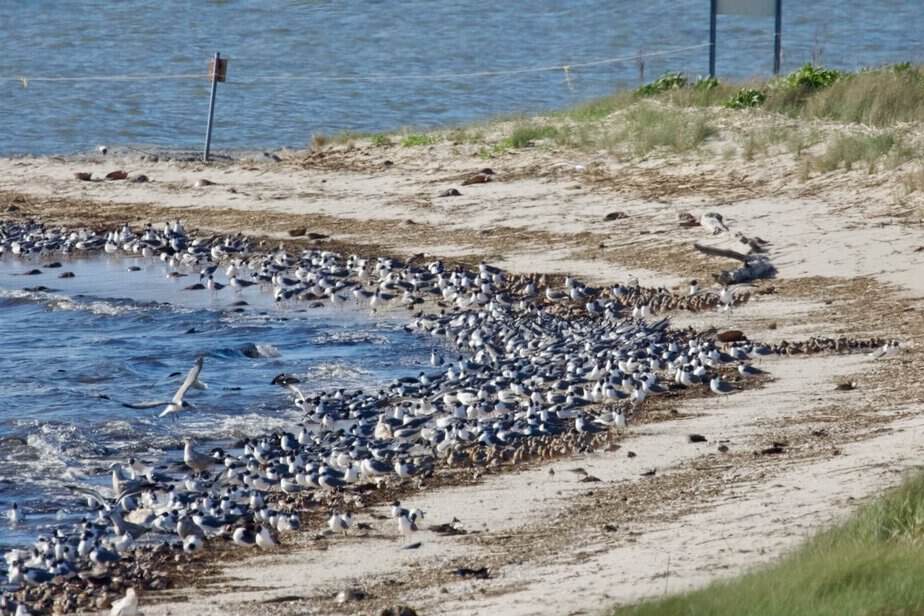
Gulls at Reeds Beach north
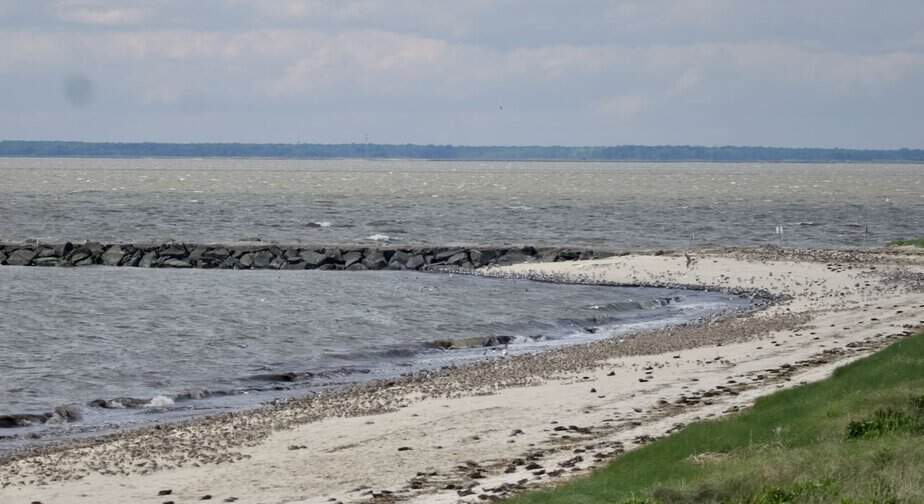
Gulls have dominated Reeds all season long because it is always dense with horseshoe crab eggs, but this year even more so. Susan Linder, leading the egg team, estimated nearly 20,000 eggs per square meter on the beach earlier in the week, when gulls covered the beach from the waterline to the high-tide line. Shorebirds had been trying to establish a beachhead but the gulls kept bullying them away. Yet when we arrived at Reeds, we were blessed with a vision of several thousand red knots and ruddy turnstones, and an even greater number of semipalmated sandpipers. They found their beachhead. We had a good catch soon after.
Since 1997, we have tracked the weights of captured shorebirds at this time to see if they reach the minimum thresholds needed for successful Arctic breeding: 180g for red knots, 155g for turnstones, and 85g for sanderlings. Initially, up to 90 percent of red knots met this target by May 26–28, allowing most birds to depart in good condition. However, after the horseshoe crab overharvest, starving birds lingered into the first week of June searching for eggs. They faced a hard, uncertain fate: shorebirds must reach the Arctic by mid-June to fledge their young before the cold rain and snow looms in mid-August.
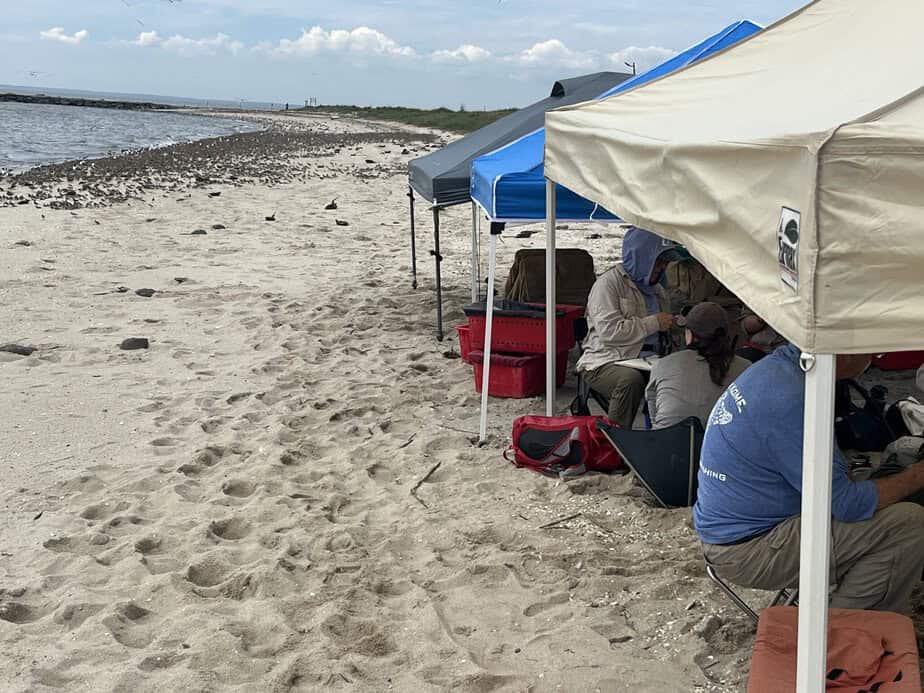
Our team works on red knots caught on Reeds Beach North, while the red knots on the beach foraged for eggs, only a hand throw from our team.
While we processed our catch, nearly 3,000 red knots packed the beach around us, hunting loose eggs. Horseshoe crab spawning has been slowing down because we have entered the neap tide phase, where high tides are much lower than during the intense spring tides of a week ago. Despite fewer eggs, shorebirds have finally established themselves on Reeds Beach because gull competition suddenly dropped by half. Now that the gulls have begun incubating their eggs, only one parent leaves the nest to feed. This gave the shorebirds enough space to take advantage of one of the few egg-dense areas left on the bay.
Yesterday’s catch of red knots and ruddy turnstones reflected this, with knot weights hovering around the 180-gram threshold. Below the weight distribution chart is a graph of P180 for knots in recent years. In most years, knots and other shorebirds have left with less than half reaching 180 grams or above. This catch showed similar percentages. But we plan another catch in a few days.
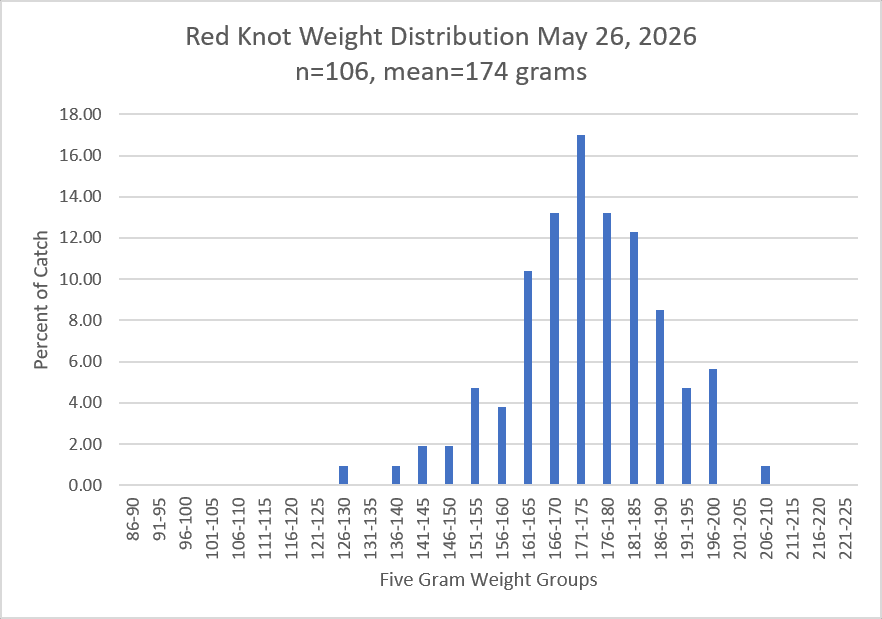
Weight distribution of Red knots caught on May 26
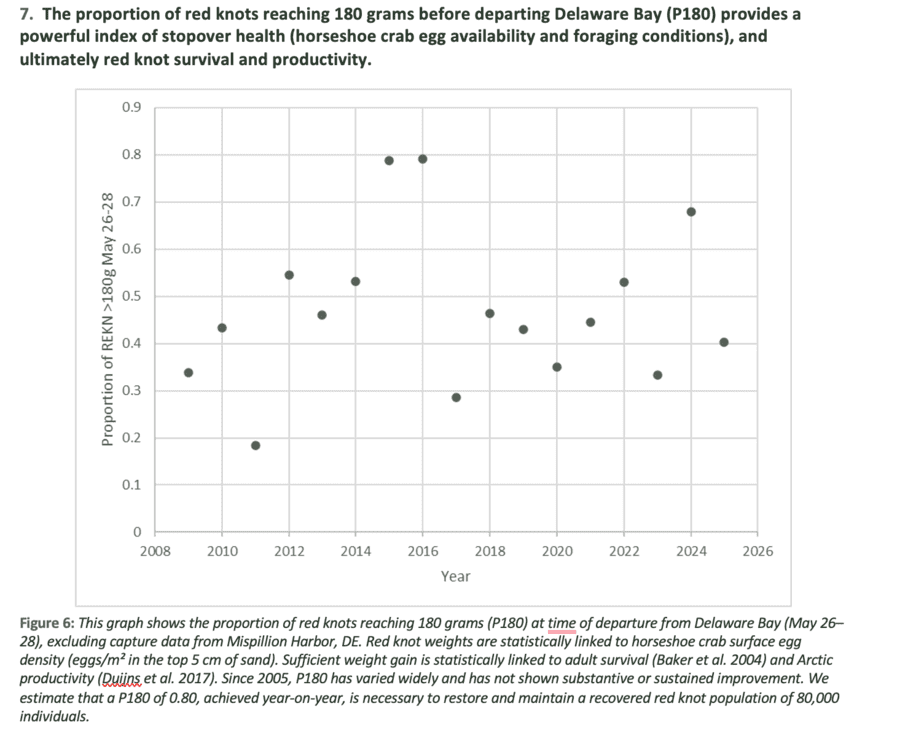
We are at a critical point in the stopover, which highlights the main problem: a lack of horseshoe crabs. If crab numbers were healthy – averaging 50,000 eggs per square meter instead of today’s sub-10,000 average – the initial spring tide spawn would have left plenty of eggs behind. Furthermore, with a larger population, crabs would be forced to spawn during the current neap tides as well, ensuring a steadier food supply for the birds.
There is only one solution to this problem: stop the killing of horseshoe crabs. The bait market for crabs is a shadow of what it was before eels and whelks were overfished. But fishers are still taking crabs, justified by the bait quota, 150,000 in Delaware and more than 300,000 in Maryland. The fishery agencies keep it all secret, so no one really knows where the crabs end up, but they almost certainly go to the multinational blood companies. These companies now manufacture synthetic alternatives for use in medical testing, but they still insist on killing crabs.
This has to end if this stopover is ever to be secure.
Next Post
